Friday, 12 June 2015

Card Spotlight: Collected Company


Collected CompanyWhen I first saw this card I saw a lot of potential. Best case scenario you get card quality, card advantage and mana advantage, not to mention tempo and trickery. Everything basically. A pair of chosen three drops into play at instant speed for just four mana. You could even get great fixing from the card if you were brazen enough to find a Geralf's Messengers and a Mantis Rider. This best case scenario rather puts to shame the mighty Bloodbraid Elf but as we all know, it is very wrong to judge a card on its best case alone. Worst case with Collected Company is a double miss and as such you are 4 mana down and 1 card down for basically nothing. I have seen a number of Bloodbraids hit things they then can't use, and it is always hilarious. Rancor, countermagic, the wrong kind of removal. The funniest was one hitting an Ancestral Visions that would have decked him. Even so, you still have a 3/2 haste for your mana. Not a disaster but not great. Bloodbraid and Company are comparable in a number of ways but what we have shown here is that Company has a much broader range of results than Elf from the much much weaker to the more powerful. It is the sign of good card design and one of the reasons it is very hard to build and maintain a cube these days. There are so many extremely high powered cards that now exist that rather require you to milk the potential from them. If you do not build around those kinds of cards you might as well not play them at all and Collected Company is exactly such a card.

Bloodbraid Elf
I had high hopes for the card and wanted it to be good and have now had a chance to play it a bunch and see how it has performed. I knew it would be important to build around it but not to what extent that would be the case. I have now cut Company from my main cube as it was simply too narrow. It was incredibly restrictive on what you could put in your deck, by the time you had put in enough good targets that the Company was worth it you didn't have enough room left for the key non-creature spells most decks need to perform. Good cube cards should be able to fit into decks easily, Company does not. I mentioned good targets, 50% of your deck might be creatures that cost three or less but you are not exactly jumping for joy when you get a pair of one drop mana dorks as your bounty. Certainly these bonus targets reduce the low end performance of the card but they do nothing to improve the top end performance of the card. To get the top end performance looking good you end up with a deck with a disgusting mana curve that is weighty on three but goes little beyond that with far too few one drops for a deck that low to the ground. Sure, this makes your company good when you play it but it makes your deck pretty horrible otherwise. This is certainly more of a thing you can do in constructed where you can have 4 copies of the Company but in cube it is pretty bad. I have seen the company be fine in some decks and good in one but that isn't enough to hold onto a cube spot for a card so specific. Multi-colour Zoo style decks are pretty good with the Company but it still fails to outperform the Bloodbraid in such lists even when built with the Company in mind. Not knowing what you are getting is a little tedious, it typically means you are playing it main phase so as to not miss out on haste and things which loses all the instant utility of the card. Just knowing you get a 3/2 haste with Bloodbraid allows you to more reliably plan your plays.
Aluren
It is the various creature based combo decks where company has a place in cube. The best deck I have used it in by a country mile was an Aluren based combo deck where you were using the card as a way to dig for the combo pieces you need. Obviously Aluren and Collected Company go pretty well hand in hand due to them both only working with CMC three or less dorks. By taking good advantage of the tutoring aspect of Collected Company you get a lot more out of the card and do not need to always be hitting two targets or high mana cost targets for it to do what you need. As such you do not need to distort your deck to accommodate the Company thus making it vastly less restrictive and damaging. Although tribal goblins is not defined as a combo deck it has far more combo elements than your typical creature based deck and as such I presume that would be another good home for Collected Company.

To confirm my experiences from testing I thought I would do some maths on the subject which mostly lead to remembering how bad I am at probability. Ultimately I had to seek help from a magical dutch maths doctor whom also loves to put numbers to the game. I wanted to see the the relationship between the % of Company targets in your deck and the odds you have on getting a dud company that gives at most one dork. Obviously the double wiff is much worse than a single wiff but both are usually sufficiently bad so as to make the Company a substantially below acceptable cube power levels. Assuming an infinite deck size for simplicity sake and exactly a 50% targets to non-targets ratio then you have about 11% chance to wiff your company, of which about 1.5% (1/64) are your odds on getting the double wiff. It does not take much to tweak a deck so that Bloodbraid cannot hit an unplayable spell, certainly a lot lot less than it does to get a list up to 50% company targets. That suddenly seems like a lot of effort when you can still do the equivalent of a Bloodbraid wiff over one in ten times and even risk the total do nothings.

Going to 52.5% threats Company hits reduces your chances of a wiff significantly being around an 8% chance to not hit two or more things. Take it all the way to 60% targets, the most I can conceivably imagine being in any sort of deck ever, and you wind up with a less than 3% chance to wiff. Slight changes make a big difference to the outcome and sadly you are typically going the other direction from the 50% mark. At 40% targets, which is still a fairly tall order and somewhat limiting on your build you have just under 5% chance to hit nothing and just under a 1 in 4 chance to not hit two things. All in all pretty weak.

Collected Company is a potentially very powerful spell however in order for it to be this way you need to have almost entirely optimal conditions for it. Either a stupendously high target count that somehow doesn't wreak your mana curve or a combo nature where you gain further value from the way in which the card works. Move away from these things even slightly and rather than an extremely powerful card you have a decidedly average cube card. Move away slightly some more and you have a pretty unplayable card. I love the card and I love the design but sadly for cube it is not something that you should be including and even in my extravagant everything cube for rotissarie I can't see it being used very often at all. Another one of those cool cards that slips by cube like Accumulated Knowledge and Squadron Hawk.


Sunday, 7 June 2015

Updated Top 16 Lifegain

Renewed Faith
I was re-reading the original best life gain spells article that I wrote only two years ago and was amazed by how much was no longer applicable. New and better cards no exist that are not on that list, those that were on the list are in wildly different places and on top of all that the importance of life gain has changed massively in the cube. Everything offensive is significantly more powerful than it used to be. The whole meta has also ramped up a bit in average converted mana cost, where once you might play Lava Dart for the added utility you would now play Searing Spear for that extra gas. Boggart-Ram Gang used to be one of the quickest clocks you could put someone on with a solid stand alone three drop. Now we have things like Rabblemaster which kills in half the time if left unchecked. Before life gain was only really relevant if you were spending it yourself or facing down a burn deck. Now most decks want a bit to sure up any aggressive matchup and for decks trying to play the long game it is a must. Life gain now gives you that much more wiggle room. A lot of threats will now make you as good as dead in two hits meaning you have a lot less time to find answers. Having a bunch of incidental life gain in your list allows you to get back into the game should such a threat get a few turns going at your face. Simply being on low life totals drastically reduces your viable options in most games and so being able to top up lets you play with much greater efficiency.

Obstinate BalothThere are lots of cards that gain life however the cube requires rather specific things from cards that offer it. This list is specifically rating the quality of the cards that you play so as to check the life gain box in your deck construction. There are more powerful cards that also gain life out there not on this list however they are in some way worse at providing the life boost than these cards. Baneslayer Angel was once high up on this list and is still a very potent card. The problem with her is that her life gain is slow and unreliable. You have to wait a turn and connect with a card that a lot of removal will take down before you get life back. In some matchups this is not that much of a problem but there are still plenty where it is. Another card that has fallen far from grace is the mighty Zuran Orb. Once atop the life gain list the little artifact barely sees any play now and the places it does are typically as a way to sacrifice lands rather than to gain life. While Orb is one of the most potent pure life gain cards it is frequently also a complete blank. With the increase in power level and average converted mana cost each card counts that much more and so you just cannot afford to have cards that do not help you out in other ways.

The key aspect of life gain for the cube is primarily the usefulness of the card that the life gain is attached to. Beyond that there is how immediate the life gain is, how much you get or can potentially get, how cheap the card or effect is and how hard it is to disrupt. There is a critical cut off point in mana cost where the potency of the card becomes less relevant overall. Baneslayer is a great card, it gives lots of life per hit and can potentially do many hits. Sadly, because it is five mana and slow to get going, although it is still a great threat, it is not a great life gain card.

Deathrite Shaman
1.   Courser of Kruphix
2.   Deathrite Shaman
3.   Thragtusk
4.   Umezawa's Jitte
5.   Sphinx's Revelation
6.   Kitchen Finks
7.   Sorin, Solemn Visitor
8.   Scavenging Ooze
9.   Siege Rhino
10. Lightning Helix
11. Elixir of Immortality
12. Absorb
13. Bow of Nylea
14. Soulfire Grandmaster
15. Wurmcoil Engine
16. Batterskull


Courser of KruphixCourser only gives one life per land made, usually just one per turn (although it does mitigate sac lands well as well as having great synergy with the shuffle!) and not always even that. The thing with Courser is that it is just so good, you would play it in most decks even without any life gain. Ongoing card advantage and information on a robust 2/4 body for 3. It is the ongoing nature of the life gain combined with its cheapness that make it so dangerous for aggressive decks. It is a high priority kill target but is sturdy for its low cost and typically saves you a lot of hurt even if it just gets you 0 or 1 life.

Deathrite Shaman is a little slower and more vulnerable than Courser, he also loses his other utility and costs you some mana should you be using him for life. This isn't even always an option should there be no creatures to exile. For this you get a card a third the cost of Courser and that offers double the life in an ongoing capacity. All told I think Deathrite has earned the best creature in all of magic title. He does so very very much and is just one mana. Sure he gets burned a lot and dies most of the time he gets into combat but for one mana, so what. It likely means your Courser is going to live that much longer! Again, it is the cheapness of the card that makes the limper life offerings that much less important.

ThragtuskThragtusk is rather a different kind of thing. Bam, five life right away but no chance on more life to come without some kind of Flicker effect. The Tusk is not a very exciting body, it dies easily and usually doesn't do all that much itself. Thragtusk is good because it is immense value, the immediate life hit and then the 3/3 guy when Tusk goes away. It reliably puts a body on the board and gives such a direct hit of life that the whole tempo dynamic wildly shifts. Suddenly you can be comfortably winning a race. He is late but this is OK because short of a counterspell the life is happening and a lot of it.

Jitte has fallen a little off lately. Still a very dangerous a highly picked card but none the less getting noticeably less play than a few years back. Better and better creatures combined with more quality removal has made the Jittle that much riskier and less impactive. A reasonably good board position can now easily overpower a Jitte where that was near impossible when it first came out. Regardless of this Jitte is still a great card and in part this is due to the life gain for which it is reasonably reliable and rather potent. Four life per connection which can be as much as 8 life per turn with re-equips for blocks or double strikers is a fair old chunk. Combined with the other options on Jitte it gives you excellent racing potential and is a bargain to get on line at just four mana total. A little easier to disrupt than some of the other life gain but well worth that risk if you have sufficient creature support.

Umezawa's JitteSphinx's Revelation is a card that offers you two of the three resources in magic paid for by the other. If you have enough mana (and of the right colours) to run Revelation you typically do so. It is expensive and gets better the more mana you sink into it. Although it comes late it is ideally a decent chunk of life and is very hard to disrupt. The combination of cards and life are usually enough to be able to turn around a game pretty effectively.

Kitchen Finks is rather like a mini Thragtusk. It is lower life overall and significantly lower right away. It is also a little easier to disrupt some of the life gain and the second body on Finks but for the price you pay these are minor things. Overall Finks is a great tempo and value dork that is the bane of most aggressive decks. The fact that it is much more of an early play really slows the momentum of an aggressive deck and winds up doing a lot more for you in those match ups when you play it at the start than a turn five Thragtusk will manage..

Sorin, Solemn VisitorSorin, Solemn Visitor is a big hit thus far in cube. While his life gain aspect is situational and disruptable it is also greatly powerful. A +1 pump to all your dorks attack as well as life link scales well with lots of dorks as well as with fatter dorks. Out of nowhere you can flop a Sorin on to a fairly dull and even board and utterly smash any chance of racing right there and then. Making 2/2 fliers when you don't have a suitable army to pump is good too and just being a planeswalker still holds lots of value as well. Sorin is potent because he offers both ongoing life gain and in potentially huge chunks.

Scavenging Ooze is along similar lines to Deathrite Shaman as a life gain card but is narrower in application and of lower power hence the lower rating on this list. Ooze still needs creatures to eat, only gives one life per trigger and also needs green mana each time. Late game Ooze is a beating as there are lots of things to eat and more mana to do so with. Early on he is far less exciting than a Kitchen Finks, Courser of Kruphix or the Deathrite Shaman. Being able to activate right away does increase his reliability as life gain but does little to improve his early performance.

Siege RhinoSiege Rhino is known for its all round power and value. Three life once is not huge but it does take the edge of things which is usually more than enough when you have a Rhino in play as well. The Rhino is marked down mostly for being an awkward three colour card that you cannot play as often as you would like. If it were not for this awkwardness he would be well above Thragtusk in this list and generally as well. A 4/5 trampling body is much much better than a 5/3, it might well still be better than a 5/3 and a 3/3 token too!


Lightning Helix is a card I have not historically had much love for however I must now concede that it is about as free as you can get life gain on a card and about as playable a card as you could hope for. Any control or midrange deck is hungry for life gain, being able to pack Incinerate, Searing Spear etc with a free three life in your deck goes a long way. Yes, it is slightly more awkward to cast but you really should be able to fire it off before you have lost all 20 of your starting life.


Elixir of ImmortalityElixir of Immortality is the non-green card of choice for any deck wishing to secure the inevitability. Time Twister effects used to be more popular but their high cost and high risk due to giving away up to seven new cards has seen them significantly decline in all bar the combo decks. With increased raw card draw power from things like Treasure Cruise and Sphinx's Revelation it is pretty easy to go through a 40 card library. Again, with only 40 cards you are spread thin on answers and may need the same one repeatedly in a long gruelling match for which the Elixir comes in handy. It is hard to disrupt Elixir and it gives a juicy immediate five life at an affordable 3 mana split into two parts. It is card disadvantage and most alike to Zuran Orb in that it seemingly does little else for you other than give some life. You only play it when you want the reusable graveyard but the life gain is what makes it playable.


AbsorbIn the cube the difference between a three mana counter and a two mana one is pretty huge. Lightning Helix is comparable to Incinerate - another very strong cube card. Absorb is comparable to Cancel - a near unplayable cube card. The life you gain from Absorb in other words is not free, you pay for it to the tune of a white mana. Some three mana counterspells do see play in the cube, mostly this is down to the distinctly finite number of unrestricted hard counter magic you can find for two mana and not because the cards themselves are super good. All of them still do a bunch more for you than Cancel however! Voidslime has much greater utility and disruption potential. Dromar's Charm again has a lot of utility and nearly made this list itself. Forbid allows for lock down abuses and can just be a useful discard outlet too. Dissipate even has decent cube utility and Dissolve some bonus value. You have to quite want your three life to forgo any of these other perks. It is just a top up on life, a small hit of three once when you counter something. Broadly playable but distinctly fair. The reason it sees so much play is that it is doing two things that are well paired, both stalling the game and it is never a dead or even that weak of a card in any given matchup. Three mana is less onerous against slower decks and the three life is that much juicier against the aggressive ones. Absorb is not a powerful card, it is just a wonderfully appropriate one and still gets a lot of play as a result.

Bow of Nylea
Bow of Nylea is somewhat of the green Elixir. It does all of what Elixir does and a bunch more as well. It is more expensive, a bit more vulnerable and less immediate on its returns but for its ongoing value and utility these are forgiven. In green control decks Bow of Nylea has time and again proven its cube value. It gives you supreme inevitability with potential to gain three life a turn, make threats grow in size or recycle potent cards back into your library. In control mirrors it is reaching comparable fear levels as Ashiok and Aetherling. As with Elixir, you only play it when you are trying to always be the control player making it more niche than a number of cards on this list but it is one of the most underrated cube cards  none the less.


Soulfire Grand Master
Soulfire Grandmaster is a new addition that might seem somewhat low down until you realise he is the very first lifelink creature to have made the list. All the other monsters have abilities or enter the battlefield effects that provide life. All those monsters that rely purely on dealing damage with lifelink are typically too slow and vulnerable to be heavily relied on as a source of extra life. Soulfire is vulnerable and somewhat slow but he affords life in several ways and is so cheap that, as with Deathrite Shaman, his vulnerabilities and sloth are substantially mitigated. Just as a 1W 2/2 life linker the Soulfire Grandmaster is one of the best cheap lifelink creatures going. Knight of Meadowgrain just doesn't do enough to see cube play these days and is the only close thing. Against another agro deck they will have to kill it right away or pause attacks so that you cannot gain life each turn with it. This is all well and good, a 2 power life linker for two is situationally great and otherwise just about fine. It is the other aspects of Grandmaster that push him over the top. Rarely does life link on your spells do much outside of red but it is fairly obnoxious when you have the burn. It is very easy to save Grandmaster till you can drop him and a burn spell on the same turn should you need to reliably gain some life. Just turning all your burn into super Lightning Helix is quite nice, when it comes to things life Bonfire of the Damned and Blasphemous Act then you can start to be far more abusive than even Sorin can manage. I gained over 100 life with the latter, Grandmaster and just three mana. He is also great as a speed bump come late game lock down card in Azorius control builds. All in all very impressive.

Wurmcoil EngineWhen you cannot get cheap cards you want that give you life you might as well get something really robust and powerful with the potential to gain vast quantities of life. Wurmcoil Engine is so good that for most aggro decks it sets the pace for when you need to have won by. If they resolve a Wurmcoil it gets disgusting very quickly short of a few good exile, bounce and tap solutions. Racing six life gain a turn is unlikely, attacking productively through the Wurmcoil is near impossible without evasion. Wurmcoil is great at providing sufficient life to keep you alive through most circumstances and is hard enough to kill that you can rely on it far more than you can with Baneslayer to be gaining you that life. Costing six and not being able to immediately gain any life means you will have to do quite a lot of work just to get to stage you can make the Wurmcoil with any semblance of safety, if at all. Great card and a great threat but not something you want to exclusively rely on to be refilling your life total.

Zuran OrbBatterskull is much like the Wurmcoil, it is robust and meaty. It is still slow, especially so when  at all disrupted, but if offers double defense with the combination of lifelink and vigilance. Once you get going with the Batterskull you are very tough to race. It is pretty much as slow as the Wurmcoil as far as this list goes and both less robust and less life returns hence being lower on the list and otherwise being very comparable. Certainly having Stoneforge in your deck makes the Batterskull vastly higher power and likely the most wanted card on this list.


Kitchen FinksThere is plenty of life gain not on this list that still gets some niche cube play as lifegain cards and also plenty of regular cube cube cards that get play but not really as any sort of life gain thing. Seeker of the Way is one of the latter, as is Baneslayer Angel. Zuran Orb is the former, as is the antiquated Ivory Tower although that shouldn't be seeing play! Vampire Nighthawk has fallen from grace a little being all to easy to knock out of the way. Dromar's Charm is a big hit of life if needed but does nothing else if used in this capacity. Renewed Faith has been seeing an increase in play lately all though not quite up to A cube standards yet. Pulse of the Fields however has not seen play in a long long time. Once the cheesy hoser of burn decks it is now not even close to viable with 4 life being far too little for the huge three mana cost. Various Ajani incarnations offer life, they are all fine but need to be played in the appropriate place to be good and in such places you are typically not doing so for any life based reasons. Warden of the First Tree is another new card with life gain potential that has been performing fairly well but is a bit narrow and far too costly and vulnerable to be relied on as life gain. Primal Command used to get a lot of love and was a substantial life infusion when needed but has been completely overshadowed by Bow of Nylea and not seen place since. Sword of War and Peace offers some life, sometimes more than Jitte, however it is less reliable at it and far less versatile and powerful. Griselbrand gives big life swings, as does Sphinx of the Steel Wind however both are the preserve of combo style decks. If Wurmcoil is on the slow side these 8 drops certainly are! Pelakka Wurm even had some love in this kind of role one, replacing the super slow Phantom Nishoba! These days such fatties are far too low powered to get a look in. Jeskai Charm is rather narrow in application however it has been brutal in a similar way to Sorin, Solemn Visitor, in that it can create a massive swing in tempo out of nowhere.


Lightning HelixAll in all there are lots of cards that are cube worthy that gain life. Some is incidental and just slightly increases the power of a card, others it is far more the reason you are playing the card. What you have to be good at doing is knowing when your deck will benefit from life gain, care nothing for it, or absolutely needs it to be viable. Once you have established which one of these three groups your deck sits in you can more sensibly find the most suitable cards for your deck. If you don't care about life at all you are likely a super aggressive deck, likely red, or some kind of a combo deck and you should consider playing Searing Spear instead of Lightning Helix as it will increase your consistency. This is only good advice in cube play, you will note modern decks do not take this advice and this is because in cube you very rarely face mirrors due to the card pool being what it is. If your deck benefits from life gain but doesn't need it then any card in the cube with any life gain potential that you want in your deck has surprisingly higher value than you might think. Early on for such a deck I might well take a Kitchen Finks over a Tarmogoyf, a slightly less powerful card that fulfils several roles. Having the Finks will round out your deck and make your matchups smoother. That bonus life gain will make a real difference when facing the burn player. Not only will it give a good buffer but it gives you more options in how you play, throw it down early and just fight the tempo directly or bait them into over extending by holding back the Finks. Lastly when your deck needs life gain you are likely a control deck or a very grindy deck. It is no longer a case of pick up the cards that give life and that you want in your deck, obviously you do that, but it is not always enough or you do not see the few cards that fit this criteria. You may well have to pick some things you don't want to and likely over things you did want and then shoehorn these random life gain things into your deck that you otherwise don't need or have better options you would rather have in the slot. You don't want to cut that Aetherling, you don't want to have no life gain but you also don't want to play two six drop threats and play the Wurmcoil as well as the Aetherling. All somewhat rough choices however the only totally incorrect one is the one without the life gain. You simply have to be aware of the issues you are creating and how to solve them. If you play both the six drop threats then you probably need to pick up a bunch more card quality effects and that sort of thing. If you were looking to play endurance or grinder control and you fail to find any suitable life gain then you likely have to try and do something else. You obviously can't be going too far away from control at this point but you likely have to be doing something really broken to be winning games. This might be playing Entreat the Angles as a quick way to steal wins. It might be going some sort of Upheaval route with a bit more ramp so as to lock people out of games. That is the joy that is magic, there is always a solution to a problem, you just have to recognize when there is a problem and respond accordingly! Life gain is an appropriate solution to several different problems you can face in magic and has a much more relevant place in the game now than ever before.


Wednesday, 3 June 2015

GoyfGate

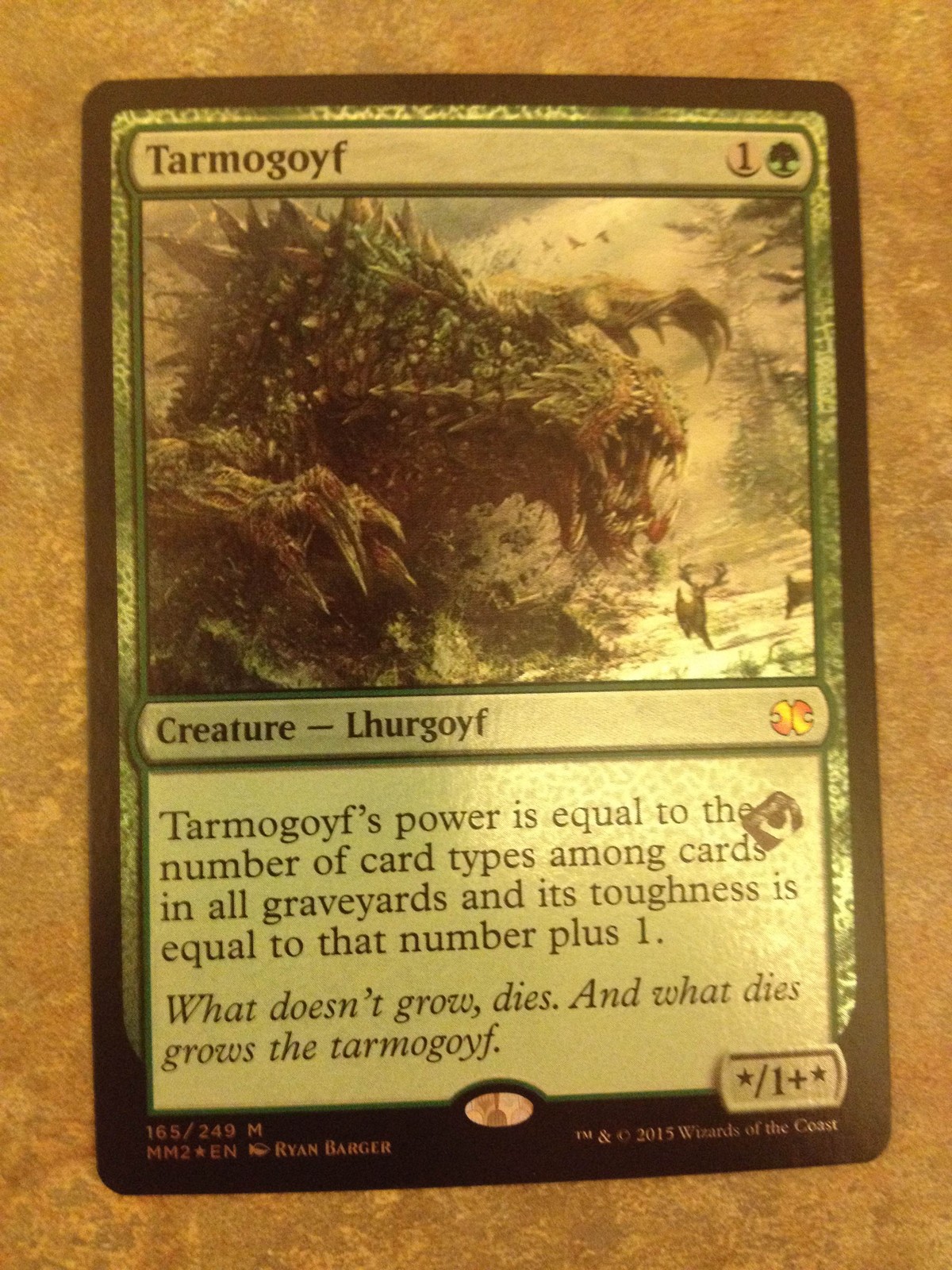
I don't normally write about the social and political side of MtG but I am more connected to this story than normal as I was discussing it as in unfolded with a friend. He told me about the pick and I laughed commenting I would probably have done the same thing. For those of you who missed the debacle, a player rare grabbed a foil Tarmogoyf (worth at least $200) in a prestigious Grand Prix top 8 over a Burst Lightning that would have gone in his deck and been amazing. Many felt this was not in the spirit of the game and a heated social media "debate" ensued. I am of the opinion that there are many reasons to game and to compete. There are the financial returns, the glory, to travel, just for fun, to meet people and socialise, simply to win and so forth. So long as you are not cheating, exploiting or being a generally unpleasant human I have no issue with the motives that inspire you to play MtG. Should your main goal be financial, a) perhaps play poker and b) picking the foil Goyf likely was the best call. The reason I would have taken the Goyf in that situation is the hedging of expectation and not purely on the resulting expected value. Should I have not taken the Goyf and just got killed in round 1 then I would be kicking my self. In that situation and I have taken the Goyf I am less put out by the whole thing, likely feeling I deserve the loss somewhat! If I win without taking the Goyf I am pretty happy but if I win and I took the Goyf I feel like a cheeky legend. Also, the Goyf is guaranteed, progression through the top 8 is not, regardless of the pick.


The prize support is not huge for a Grand Prix, the difference between coming 4-8th and coming 1st is $3.5k or so, the diff between 4-8th and 3rd/4th is only $500. The difference between having a top rate Burst Lightning in your deck and some weak generic filler dork isn't going to do much more than shift your win percentage by 2 resulting in a match win percentage looking more like 4. The might returns on 4% of $500 is a tenth that of the Goyf, sure there is more for grabs later on but as you have to win the previous rounds the contributions from the matchup % differences do not add up to much.

It later transpired the Goyf grabber was knocked out by his opponent ripping the card he should have picked. Equally funny and some good karma but not maliciously, just in the sense that it is a good storey. Amused as I was I didn't care about him being knocked out, much like I didn't care that he picked the Goyf and much like I wouldn't have cared had he won. Had I been in that top 8, playing green and receiving the pack from said Goyf grabber than likely I would have cared a whole lot more. I wasn't and I didn't. I am one magic anecdote up and it cost me nothing more than the time to hear about it.

Our hero of the storey is not done yet with karmic justice however. After the event is all done he places the foil Goyf on e-bay and in a genius move pledges to give half the proceeds to charity. With all the fuss surrounding the incident it attracted attention and quickly flew past the $200 or so normal value for a foil Goyf. We are now sat at just under $16k with several days left to go on the auction. Even after the charity cut our hero is looking at double what he would have received for winning the Grand Prix! All those people getting on their high horses, saying mean things and taking a game way too seriously somewhat have egg on face. They certainly helped get the bids up nice and high.

There are many lessons in this series of events. Be nice and don't get over zealous about fairly minor things would be one. The most significant one is that MtG is dangerously expensive to get into and play with cards worth far too much. If the prizes of one of the biggest tournaments going isn't incentive enough to get people playing the game as intended then there is an issue. The high value of certain cards used in tournament play greatly hinders the game at all levels, including as we have seen, the very highest.


Friday, 29 May 2015

Top Sixteen Bounce Spells

Boomerang
Bounce spells are plentiful in cube and come in lots of shapes and sized. They are not often heralded as power spells but they are good tempo and disruption tools and the best blue has got in terms of removing permanents. Used well or in the right sort of decks bounce spells are among the most powerful kinds of removal while used poorly you might as well just be playing Healing Salve or something comparably underpowered. That makes them my kind of card, something you can engineer to be above the curve, something that has a broad range of uses and something people are not always vigilant about playing around. Bounce comes in one shot spell form, one shot enter the battlefeild effects on dorks, and ongoing bounce effects on various permanents. I have decided to limit this list to those things that are one shot only as they function much more similarly and fulfil the same kind of broad role.


Cryptic Command1.   Cryptic Command
2.   Cyclonic Rift
3.   Upheaval
4.   Venser, Shaper Savant
5.   Vapor Snag
6.   Boomerang
7.   Riftwing Cloudskate
8.   Capsize
9.   Repulse
10. Into the Roil
11. Eye to Nowhere
12. Aether Adept / Man-o-War
13. Wipe Away
14. Repeal
15. Hoodwink
16. Recoil


Cyclonic RiftObviously Cryptic Command comes in top, it is the most powerful and playable card on the list by a good chunk and likely would remain so even if you always had to chose bounce as one of the options! Tempo, trickery, utility and value. Cryptic Command gets you out of a jam like no other blue card. The bounce is a big part of that, being so broad yet costing you very little because of the bonus effects you can get with it.

Cyclonic Rift is more of a pure bounce spell, basically it just bounces a thing and is highly comparable to a lot of the cards on this list like Boomerang and Into the Roil. There are some issues with the Rift, it doesn't hit lands nor does it hit your own things. Hitting lands can really let you exploit certain situations and is a huge help against man lands. Bouncing your own stuff is horrendous for tempo but none the less is often worth doing in the long games where you rely on a certain threat to win or really need the extra value from an enter the battlefield effect. These are both annoyances that you can live with because of the insane overload ability which turns the card from a humble single target bounce spell into a one sided mass removal spell of doom. Any slow clunky deck using planeswalkers and dorks, say an Abzan deck, gets utterly brutalized by Cyclonic Rift. Early on Rift provides some generic tempo and safety should you need it. Then it becomes one of the best mass removal spells in the game when you hit 7 mana and can be used to steal games you are behind in easily. It might not kill anything beyond tokens but returning everything with a cost is a huge setback that takes several turns to recover. This on top of being instant and one sided make it so easy to put yourself unrecoverably ahead.

UpheavalUpheaval is a bit old school and niche yet it remains one of the most powerful and exploitable cards in all of magic. Upheaval is a lot like Rift but it does more for less. In part this is because it has no cheap mode and in part because it is symmetrical. Rift sees a lot more play because you don't really need to do much to exploit it, you can just throw it in a deck and have it be good. Upheaval you really have to work at so that it doesn't wreak you just as much as your opponent. When you have such a deck then Upheaval is one of the most game ending and unrecoverable things that you can be doing, bouncing everything is a lot more brutal when you have no lands left to play the things again with either! Typically the decks that best exploit Upheaval involve lots of artifact mana sources and some cheap yet potent threat. It may see less play than it used to but it is no weaker and no less scary.                    


Venser, Shaper SavantVenser, Shaper Savant is the poor mans Cryptic Command. His Remand mode is overlooked as a four mana Remand is not often that exciting but it does somewhat give Venser the feel of having nearly as many modes as Cryptic. There is lots of delve and flashback in the cube against which Venser is very potent. Although he costs a lot for bounce he is instant and hits any target which are two of the most important aspects of bounce spells. Overall he is a great utility card and something you often reach for when you have reason to want more bodies in your deck such as equipment. A 2/2 with nothing nice like flying leaves a lot to be desired and so unless you flash him in to get an unusually good block he is relatively low value compared to the mighty Cryptic.


Vapor SnagVapour Snag has been jokingly called the blue Path or Plow. Laughable as this comparison seems there are plenty of decks that play the Snag for which it is basically an accurate one. Usually you are wanting to hit dorks with your bounce, certainly it vastly reduces the utility of the card having only creatures as potential targets but it doesn't much affect the power. Paying just one mana to instantly remove a creature from play is nice. Getting a free ping in as well is a lovely kicker. Typically it is the more aggressive decks that play Snag over broader bounce and so that damage is relevant. Likewise, the aggro decks dont much care about taking pain themselves and so you don't lose that much utility on the card as a way of bouncing your own dorks. The most common home for this card is the aggro blue red deck where it compliments burn brilliantly. Burn the little things efficiently and bounce the big things you cannot burn easily. The thing that makes this card slightly more annoying and therefore slightly less played is not that you don't kill the thing you bounce but that so many cube cards have enter the battlefield effects you don't really want to give them again. You want to hit cards like Brimaz, big fat dorks that need to get into combat before they have done much, if you hit these kinds of card there is a good chance you won't see it played again, they will either be dead before they have the time or will have won anyway regardless of the Brimaz they have in hand. Overall Snag is one of the more brutal single target bounce spells but it is more niche than most of the others. Seal of Removal and Unsummon have both had their time in the cube but the Snag won out in the end. Seal was nice for devotion but had terrible synergy with Delver of Secrets and Snapcaster Mage. Unsummon wasn't exciting enough over Snag for the slower decks and was directly worse for the aggro ones. There really doesn't feel like there is room in a cube for more than one creature only one mana bounce spell even in a 720 cards cube hence the other two very comparable cards not even making this list.

Riftwing Cloudskate

Boomerang, the original bounce spell, the counterpart to Counterspell. Two mana, anything in play, not in play, instantly. Simple. Elegant. Wonderful. I was going to do, and still might, a comparison of Counterspell and Boomerang to Vindicate so as to show that either of the blue spells are quite substantially better in the right situation but pay for it by being that much more context dependant. When you have situations where they will not be getting the chance to usefully replay the card in question Boomerang is comically better than Vindicate, one less mana, one less colour, instant speed and not even triggering any "when this dies" effects. I have won a lot of games simply by throwing out a Boomerang on their land as soon as I can. You need to know the matchup or have a good read/Peek style information to sensibly make that kind of call but it is a nice easy win when you get it right. Just another one of those blue cards that used right can give that Time Walk feeling. Although such free wins are nice they are significantly less common than Cyclonic Rift overload is relevant hence it not being higher on the list.
Capsize
Riftwing Cloudskate is the first of the sorcery speed bounce spells to make the list. It has two casting modes with the suspend which adds to the utility however the sloth and the price sufficiently detract from the utility that I think you wind up with a reasonably below par bounce effect. To offset this you get a 2/2 flier which unlike Venser is a pretty useful body to have floating about, nibbling away at planeswalkers and lifetotals. You play this card mostly for the dork, the bounce is a pleasant perk that is rarely useless and sometimes pretty good. As such this is almost exclusively used in more aggressive decks where you want a body and often (being blue) have a deficit of two drops. Bounce somewhat scales well with more bounce and so Riftwing's bounce aspect is that much more potent when you have more of a bounce theme going on.

Capsize has seen most play as a finisher / out in combo style decks that make lots of mana. It is pretty hard for most decks to beat single Capsize a turn, as many as you like is almost impossible to beat! Capsize hits all targets and does so at instant speed but is either 3 or 6 mana. Like countermagic, 3 mana bounce is substantially harder to use well and less exciting than the two mana options. It feels really hard to get ahead using it. Being able to maintain parity might be all you need and having a card that can keep you a bit safer early on and then go on to lock someone out of the game entirely is nice, it just requires fairly specific decks. Control used to get away with things this slow or mana intensive, now adays you are going to really struggle beating planeswalkers and Titans with your Capsize plan....

RepulseRepulse is a great little filler card that is in a bunch of cubes and has been in and out of mine. It is much more of a draft card than one you would include when you are constructing decks with a cube. It costs three mana and only hits dorks but it replaces itself thus typically costing you less than your opponent. Being instant allows you engineer further advantage with it than just a mana one. Overall a very fair card. Like Vapour Snag it is a little let down by so many cube cards having come into play effects that you don't want to give your opponents back. It is the same kind of annoyance you face when building with cards like Doom Blade that fail to kill black creatures.


Into the RoilInto the Roil is very comparable to Boomerang, it is slightly better for normal use but much less good in a heavy bounce strategy. You can build decks with the aim of attacking mana bases and do so with bounce fairly well and Into the Roil has no place in such decks. The reward you get from Roil for not being able to target lands is an easier casting cost of 1U and a kicker for the same cost again to draw you a card and represent Cryptic Command in bounce draw mode. Roil enjoyed A cube position until Rift was printed and has not been played again since. As with creature only one mana bounce, I think two mana non land bounce only really has one slot open to it in a cube and so despite this being a very rounded and nice card I fear we have seen the last of it. In a vacuum this is one of the better bounce spells yet is does nothing better than anything else and so gets rather marked down for it.


Eye of NowhereEye to Nowhere is essentially just a sorcery speed Boomerang. This makes it pretty terrible except when bouncing lands at which point it is basically just as good. When you are going a blue mana denial route this card is one of your better options, if you are doing anything else this shouldn't be anywhere near your deck.


Aether Adept and Man-o-War are essentially the same card. The Adept is slightly better overall  but it is marginal enough that I have ranked them together. Adept is a more useful creature type and has some synergy with things like Voidmage, all B or C cube cards but synergies Man-o-War none the less lacks. Typically you are playing these cards in heavier blue decks and so UU in the cost is more of a help towards devotion than it is a hindrance to casting. Despite being a good tempo cards and fairly well priced the lack lustre 2/2 vanilla body rather lets the card down. On top of this the creature only sorcery speed bounce has far far more limited use than most of the rest of the bounce on this list and as such these cards rarely see play these days. When I first made my cube 10 years ago I think most people would have put the old jellyfish in the top couple of blue creatures!
Man-o'-War

Wipe Away is another very niche bounce spell. It does all the things you want a bounce spell to do but it charges you the clumsy three mana price. The perk for this overcosting is split second which sounds exciting and nice but in reality has very few actual applications in the cube. The most notable is in being able to "deal" with an Aetherling. It is not just the best blue spell at dealing with an in play Aetherling but it is one of the best period. With a few more such applications the card might eventually earn a permanent cube slot but for now it is far too underwhelming a card that offers little that Boomerang does not.


Wipe Away
Repeal is a rather more swingy bounce card than most. It is downright awful at dealing with Reanimate decks or even just hard cast Titans. It is however the best bounce card going at taking out some kind of token. Unless you know you have a specific good use for the card I would suggest this is actually a bad bounce spell. Sure you get to draw a card which makes it card neutral however you almost always guarantee that you are the one losing out on mana advantage. Mana advantage and broad range are the two main perks of bounce effects and this offers neither. I have lost to affinity creatures while playing with this, I imagine Tasigur would be a common new card for this to fold to pretty hard should you still have it in your cubes. Potentially this is very potent but usually it is the wrong card.


Repeal
Hoodwink is an oddity as it is the only bounce card on this list that doesn't hit creatures. You play it, like Eye of Nowhere, as a blue mana denial card. As such its easier casting cost and instant speed do not do that much in its favour. After your Boomerang, your Eye to Nowhere and your higher quality 3+ mana bounce and mana denial if you still feel like you need more land disruption then you might dig out this little card. Niche, and far down the list of land bouncers but still more played than many bounce spells.


RecoilRecoil has been called the instant Vindicate which is more generous than equating Vapour Snag to Path to Exile. Discard and bounce have no real synergy with each other until you have exhausted their hand. As such this is usually just a bad Repulse or bad Capsize. Even if you are so heavy on discard that you can have this always be vindicate you would probably still rather other bounce as you will more than likely have spare discard effects. This is also a gold card making it worse too!


Jace, the Mind Sculptor, Waterfront Bouncer and to a lesser extent Tradewind Rider and Crystal Shard are the main examples of ongoing bounce effects used in cube. Jace is the clear best but much of this is down to the great versatility of the card beyond the mere capacity to bounce. Bouncer has fallen off a little in the less combo-y cube but is a nice cheap little card that does a lot of work. It would likely be about 8th on this list (9th if we are putting Jace in as well) but as I said at the start, the ongoing effects are not so directly comparable meaning that rating is more about performance in the cube rather than quality as a bounce card.


Tuesday, 19 May 2015

Why is Blue the best colour?

I think if you asked most seasoned magic players what the commonly regarded best colour in MtG was they would basically all say blue. I am obviously writing this from a cuber perspective, there are plenty of blocks and standard formats where blue has been weak. With this being from the perspective of cube it will also largely apply to legacy, vintage, EDH, the theoretical "best of all time" and also fairly well to modern. You could simply argue that blue has the best and most powerful individual cards which leads to it being the best colour. This is true but does not satisfactorily explain the whole of the why.

Azure DrakeThere are broadly speaking two kinds of cube, those that are powered and those that are not. I would assert that blue remains the most powerful colour in both but it is significantly closer in the unpowered cubes. Once you strip away the colourless cards from the power and older cards that are similarly above the curve you are basically only left with blue cards and Fastbond. I do not even consider Timetwister to be above the curve however Time Walk, Ancestral Recall and Mana Drain are all disgustingly over powered to the point I have banned them in my cube so as to have fairer more fun games. If I can satisfy why blue is the most powerful in an unpowered cube it should be fairly easy to accept that it is also the case in a powered one.


I shall start off by arguing some reasons why blue is weak as a colour and then try and explain what it is about blue cards that sufficiently offset these limitations such that blue can be considered the most powerful colour. If you are only allowed to build mono coloured decks then blue quickly becomes one of the weakest colours. It has weaker creatures in terms of their potency in combat and presence on the board. It is also the shallowest in terms of creature quality, it has some very powerful ones but remove them and you are not left with much at all. Blue leans very hard on artifacts when being played as mono to support it in the areas in which it is weaker. Blue can compete as mono but it has to be built with what your opponents are doing heavily in mind, stretch it too far and it has no hope but you can tune it to deal with several different decks fairly well. Blue cannot destroy things, this is the main weakness of the colour along with flimsy minions. Typically it is for destroying things that you employ artifacts in mono blue decks. Not being able to directly destroy things means that you are vulnerable to all manner of things people can put into play. A Grim Lavamancer can be death to anything you can play, an early Ankh of Mishra can be too much damage. Certainly blue can counter things or bounce them or both, it can even just steal them. This is typically fine against the larger permanents but it is far too inefficient against cheaper cards.

Every colour has strengths and weaknesses. This discussion about blue in mono covers the weaknesses of blue and also suggests that those weaknesses are more severe in blue than they are in other colours. This would stand to reason as it would somewhat balance the extreme positives of the colour. The thing is, magic is a game where you can mix and match your colours and design your decks. Some of the best cards are those with drawbacks that you can, through deck design, mitigate such that you have a greatly over powered card. Broadly speaking this is why blue is so good, you can exploit it strengths while mitigating its weaknesses using clever design and the qualities of other colours.

Apprentice SorcererSo, what are these exploitable strengths that blue has and what is it about them that makes them stand out above all the other colours. I would group blues strengths into three categories of card types; counterspells, card draw and card quality. Counterspells are almost entirely unique to blue, those few that there are outside the colour are typically far too niche for cube play or are just complete shite. Card quality is becoming more available to other colours but blue still has the most, the best and the cheapest of the card quality spells. It has all the most generic library and hand manipulation as well as the best of the more universal scry cards. Card advantage is also becoming more available to other colours in many different forms, typically this is through incremental advantages on the likes of planeswalkers or two for one style creatures. Blue has card advantage  of this kind and some pretty good effects at that but it also has lots of card advantage that offers that advantage as cards in hand rather than your dork back or two effects in one spell etc. Cards in hand is obviously the most rounded and generic form of card advantage, it allows you to do whatever you want with those cards and your deck design. Outside of blue it is both rare and difficult to get a grip full of juicy cards from your library. Black has some tools like Necropotence but they are painful and need to be very carefully built around. Green has some stuff but they all require you to have loads of dorks in play or cast loads of dorks to trigger. Red has, er, Wheel of Fortune. If you just want a card that costs some mana and does little more than leaving you with a bigger hand than before you cast it you really have to look to blue.

Boomerang
All three of blues strengths are pretty exclusive to blue. Some other colours have a pretty exclusive thing, direct damage in red, permanent ramp in green (although artifacts can adequately fulfil this role), discard effects in black, but it is one thing not three, and excluding red's direct damage not in quite the same league as the blue stuff. Blue might have weaker creatures but it still has creatures, no other colour has counterspells. Removal and creatures being the weakness of blue make it very easy to offset. All the other colours have stronger monsters and are much more comparable in overall strength than the blue ones are so you can go blue X and happily have monsters that will go toe to toe with other decks. Likewise with removal, blue can deal with stuff in a roundabout way, it is like having weaker creatures. All other colours have removal for some permanent types so your given blue X pairing will not only sort you out for dorks but it will cover you pretty well for removal too. Having unique strengths is great as it means everything can gain access to new tools by pairing with you and likewise, having unique weaknesses is also good as it means help is at hand wherever you look for it.

Deep Analysis
I shouldn't really need to justify why card advantage is good but I am going to have a quick stab at it anyway. It is always hardest to explain why the obviously good is good. Essentially magic has 3 resources, life, cards and mana. As we know, life is pretty irrelevant, there is only one point of it that matters at all, the rest is just buffing. Once you are winning the life aspect of the game will take care of itself. As for the other two, you spend your mana on your cards, often trading your cards with your opponent. Those trades that are more mana disparate will afford tempo to the player paying less. Likewise, those trades that are not equal in cards will offer card advantage to the player using fewer cards or parts of cards to deal with things. You can either win by gaining too much tempo on your opponent that they are overpowered and die or you can outlast someone and trade off until they have no cards left and you still do. Combo decks don't quite work like this but still love to draw more cards. Regardless of them, card advantage is one of the two main paths to victory in magic. Card advantage that comes as cards in hand is the most universally playable and useful and so blue has a good edge on the other colours.

Lat-Nam's Legacy
I recently did an article on card quality that goes into some detail about why it is so good and which cards are the best for cube use. Unsurprisingly the list was predominantly blue and almost all the outlying cards that did not make the top X were also blue. Put simply rather than in 10,000 words or so... magic is a random game. Card quality reduces the randomness and makes you more consistent. Lots of games are lost through floods and screws and card quality is some insurance against those losses you cannot do anything about. It is not just insurance but also gives you the ability to outplay people in the more even games. Card quality spells give you a lot more options and much more immediacy on those options than most other types of cards, especially if we are talking choices per mana spent. Choices let you play the game and let you use more skill as well as luck and card power to win games.

Before we go on to look at countermagic I want to consider the scaling effect of card draw and card quality. At the start of this article I commented that this was from the perspective of cube but it would also apply to a bunch of other formats, apply reasonably to modern, but not always to the standard and block formats. While some blocks just fail to support some colours well this is not the only reason behind the trend of having a larger pool of cards and blue becoming more powerful and vice versa, blue being weaker in smaller pools. Card quality and card draw generically scale well with power. The more powerful cards you have the more value there is on drawing more of them or having the right ones at the right time. Good creatures or say, burn spells don't have quite the same inbuilt scaling with the power of other cards. Not only are card draw and quality effects very good in their own right or in a vacuum so to speak, they are able to become more and more powerful based on the power of what you put them with. Thus, the broadest and biggest formats like cube are where the potency of blue is most noticeable.
Copy Artifact
A small side note on this general area which applies far more to powered cubes but still bears some relevance to unpowered cubes; Blue has the most synergy with artifacts as part of its colour pie flavour. Blue just has more cards that interact and scale well with artifacts than any other colour. Red is close but the other three barely do anything useful with them! Much like the scaling of card quality and card advantage with powerful cards, blue in general scales well with the power and number of the available artifacts in a given format.

There is even the simple argument that good cards make other cards better. I have already used the hateful phrase "in a vacuum" in this essay but it is a fairly useless concept in magic. There is no vacuum, cards necessarily interact with each other. A good card in blue brings up the quality of the other blue cards as they are easier to play with this one good card. The more good cards you add into this generic pool of good cards the better the total resulting power is. Blue has a great depth of very good cards, all of which make each other and the more average cards that much better overall. It is almost getting a bit chicken and egg saying that blue has a lot of great cards because blue has a great cards but at least Wittgenstien would approve. It is more like capitalism, once you (or blue in this metaphor) are rich and powerful it is far easier to become more rich and powerful.

Foil
So finally we come to counterspells, the thing most associated with blue. An effect loved and feared by magicians the world over and something we can effectively say is unique to blue. For the record, I think this exclusivity is an error in the design of magic, I would love to see some carefully designed playable counter effects in other colours that remained reasonably true to the feel of the colour. Say, an Annul for 1G that also drew you a card. Perhaps colourshifting Delay to red would be reasonable too. Mana Tithe is about the only half playable example of such a card yet printed. Giving broad and/or hard countermagic to other colours wouldn't be good either but having little to nothing in that sphere makes non-blue colours far more limited and vulnerable. In the cube, if I build a non-blue deck there are invariably a wide array of things you simply cannot beat in anyway. Loads of combo decks that are relatively non interactive will just free win if you are not putting them on some sort of decent clock. There can be tools to deal with specific combos outside of blue but they are sideboard cards, not the sort of thing you put in cubes and not the kind of thing that is fun to play with. Giving the non-blue colours some protection against spells would improve the diversity of the game immensely.

You might argue that black has good protection against spells through the use of discard and this is true to some extent but really that is like comparing bounce to hard removal. A Duress will perform much the same role as a counterspell should you a; cast it before they can cast their offending spell. b; cast it after they draw the offending spell which is of course not always possible. You also need to fire off your Duress before they empty their hand of spells else it will achieve nothing. Sure, Duress is half the price of Counterspell and doesn't require you to have the mana available at quite such a specific time but it is still substantially weaker and less safe. Discard is typically used as stall, disruption that will buy you a good amount of time and be awkward. It is not used as a way to lock down anything scary your opponent might do, rather obviously because it would fail horribly in this task!

Withering BoonThis is the crux of why countermagic is so strong. It is the only thing that provides protection against spells in any sort of reliable or ongoing way. On top of this exclusive spell protection countermagic typically provides a general form of removal/disruption. Dissipate does basically the same as Council's Judgement for any spell that makes permanents and it effects instants and sorceries too! Cancel does most of what Maelstrom Pulse does and more. Yes, you have to have the counterspell and the mana for it at the right time which is not the case for the removal spells but this is a small price to pay for such a powerful effect and that only makes up a part of what the card does for you.

Let us look at Tinker, another sick powerful blue card! The options available to other colours to be able to deal with Tinker are as follows, black has to hit it with a discard spell before cast and after drawn or deal with the thing it gets. Every other colour has to deal with the thing it gets. I guess white could respond with a Containment priest but this is the kind of specific sideboard nonsense that you don't want to have to resort to. Blue knows most colours will just have to try and deal with the thing they get with Tinker and typically plays a few things that each colour really struggles with. Red and green pretty much can't deal with a Sphinx of the Steel Wind so that is a nice easy win. Blue folds pretty hard to an Inkwell Leviathan. Black and white can be a little trickier to present an unkillable threat to but you can still make it awkward as hell for them. Black does not have an easy time with the cheap Wurmcoil Engine for example. The point is Tinker is a cheap spell that you can do really very little about efficiently or comfortably outside of blue or lucky black and Tinker is just one such example of a powerful spell that is hard to disrupt well.

Counterspells are typically associated with control but this is not because they are only good in control, quite the opposite. Countermagic is usually found in control because it is very difficult indeed to make a deck capable of dealing with all the things a cube can throw at you without countermagic. There are some very good aggressive strategies that employ countermagic to good effect too. Countermagic is great at protecting you, it is like good generic removal as well as good generic disruption. It will ease the burden on your pure removal cards and it will force your opponent to play with more caution and restraint.

I would agree that Actual Counterspell is somewhat above the curve and a big part of why so many magic players hate countermagic. Negate, Mana Leak and something like Dissolve are far fairer and more balanced examples of what countermagic should be. These fair counterspells represent the bottom end of what is good in cube, I don't even have a Dissolve in mine favouring Forbid in that slot. Fair counterspells still represent an exclusive thing in magic and still offer the best kind of safety against spells. Blue however has plenty of unfair ones which only serve to make the colour even more powerful. If the Forces of Will, Mana Drains, Arcane Denials, Cryptic Commands, Remands and Spell Pierces were never printed I am pretty sure the cube would still have a similar total number of counterspell style cards, it would just play more of the weaker ones in their place.

Countermagic is powerful in principle because it is an exclusive effect that is broad in application. It is the only real protection against instants and sorceries yet it does a good job of doing the role of your Vindicates and Hero's Downfall. It too scales well with and against powerful cards and also scales well with broadening and diversifying formats. With all this going for them those counterspells that fall above the curve gain a lot in power very quickly.

Time Spiral
The focus of this essay has been on card draw and quality and countermagic being the main reasons why blue is the best colour. This is true but not the only things blue has going for it. Blue has some of the most interesting, powerful and unique cards and effects in magic. Things like Upheaval, Show and Tell, Mind Over Matter, Omniscience, Time Walk effects, Turn About and so on. These cards do rather fall into the category of cards made better by the other cards in blue. Blue is one of the best combo colours because of the support from card draw, quality and countermagic. Bubbling Muck is not a card that got much love while High Tide is a much feared archetype. Blue does have a lot of great combo cards but they are at an inherent advantage over other colours combo cards because they are blue.

There we have it, the collection of reasons why blue is the best colour as far as I can discern them.


Monday, 18 May 2015

Humans


Mayor of AvabruckI love to do a tribal deck yet have to date not done an article for my own species! There are lots of humans, they cover all the colours and have a wide rage of, well, pretty much everything. The thing with humans is that they have historically been a default or filler creature type. They are in most realms and don't have that much synergy, or didn't until Innistrad block where they started to get some tribal love. I have done a couple of iterations of human decks, always a heavy white base but then sometimes mono, sometimes a black splash, sometimes a green one, sometimes more than a spalsh etc. Although they have had human themes they have not really drawn very heavily on the synergy cards and are more flavour than function. This is one of my favourite lists to date as it has the most reasons to have humans. It offers a lot of power and tenacity despite being so low to the ground. It contains a couple of more niche cards that shouldn't be in most cubes however the bulk of the deck is cube staples. As cube tribal decks go this is one of the easiest to support without leaving your packs full of awful last picks. A lot of this is because there are really not that many human synergy cards and most of those that are good enough for this deck are quite viable without much of a tribal focus. Again, a lot of this is because there are so many incidental humans that things like Champion of the Parish are viable in most decks that would want it.


Dragon Hunter
25 Spells


Mother of Runes
Gideon's Lawkeeper
Champion of the Parish
Student of Warfare

Soldier of the Pantheon
Mardu Woe-Reaper
Dragon Hunter
Path to Exile

Warden of the First Tree
Deathrite Shaman
Warden of the First TreeNoble Hierarch
Avacyn Pilgrim


Gather the Townsfolk
Mayor of Avabruk
Selesnya Charm
Dromoka's Command

Knight of the White Orchid
Precint Captain
Loyal Cathar
Hamlet Captain

Thalia, Guardian of Threben

Silverblade Paladin
Ajani, Caller of the Pride

Armageddon

Obelisk of Urd

15 Lands


Hamlet Captain
So, you have three tribal humans cards and a potent tribal pump effect in Obelisk of Urd. Champion and Mayor are solid cards you can reasonably see in cubes. Hamlet Captain is not. The rest of the deck is simply the best cheap green and white humans I cold find. Captain is fine but likely a powerful stand alone card without synergy would be as good if not better, I just like to go deep on things when trying them out. I played black mana sources in this list so that I could more easily activate Warden and Deathrite, this makes Dark Confidant an incredibly tempting human however with so many WW cards and the huge colour intensity of all those one drops I preferred not to risk it. Consistency is king in magic. I only had a couple of black mana sources in the deck and would have needed way more than that to support and card that needs black mana rather than just has a use for it. Many more black sources and my mana base gets substantially worse and rather more painful too.

Dromoka's Command
The Charm and Command give you some great outs, tricks and general tempo without costing you any consistency due to their great versatility. Some artifact removal within the list would have been nice. Having three mana dorks (including Deathrite) in the list is a little extreme given how cheap the deck is but two of them are doing other very useful things as well, some of the things you make are mana intense, it allows you to skimp a little more on lands and it gives you extra burst. The cheapness of the deck and the mana dorks made Armageddon too good to turn down. It is such a danger card against so many archetypes it will give you value just having it in the list. Those not wary of it will give you the odd free win too. Ajani and Path to Exile are the only other non human themed cards in the deck. Path is just great in this deck and needs little justification. With the Command and Charm as well this deck has actually got some serious killing potential which is not something common to this style of deck nor this colour pairing.

Ajani, Caller of the PrideI played Ajani in this deck to diversify my threats. Being able to pressure your opponents in several ways is a great advantage in any aggressive deck. It allows you to extend more without serious repercussions while putting more demands on your opponents. While Caller of the Pride is not the best Ajani incarnation nor is it easy to slot into any given deck it was highly appropriate in this list. Being one mana cheaper works really well with your lower than usual curve. It either sends things over the top to close a game or makes your threats more dangerous giving you ongoing advantage. Little dorks are the best to counter up, they are the least savage to have killed and improve more significantly as a relevant thing on the board than is the case when pumping larger monsters. A high count of cheap minions is also the best way to reliably have a target for Ajani. One of the reasons so many incarnations of Ajani struggle is because they do so little useful when you don't have something to go with them and for this deck that is not so much of a problem. Elspeth, Knight-Errant is way more powerful and would have worked very well in this deck as well but that extra mana would have really hurt. I was very happy with my choice to pack Caller of the Pride in this list.
Obelisk of Urd

Obelisk of Urd is an unusual card that gives you a lot of options. If you are curving out well you can easily cast it on turn three but in order to do you need to skip all your attacks that turn. Should you have utility dorks like Mother of Runes you need to turn those off which is another risk. The longer you leave your Urd the less it impacts your immediate pressure but not by much, the deck does not go past four mana very quickly at all. As we have seen from Tempered Steel, +2/+2 to all your men is really rather made of win and makes life very hard for almost every deck going. Skipping your attacks to flop out an Obelisk is horrendous should they just kill it with some artifact removal, it is pretty bad if they wrath your team, it will take several turns to get back on track even with the Urd still in play. A powerful card that is very strong in tribal decks, especially those with a low curve, high creature count and/or lots of tokens. Caution is advised however, it is not just that hardest global pump spell to play with but one of the riskier ones as well.

Broadly the deck played like a white weenie deck, it would apply some early pressure then should that not result in a win it would clogg up the board and create stand offs in which it had several good ways to punch through or simply break. I found I had way more options with this list than your average white weenie deck due to the more interesting array of minions, the lower curve and the extra ramp. I also found I maintained the early tempo advantage longer than usual due to the high amount of removal in the list. I felt this deck had one last advantage over a standard white weenie list and that was the late game where you have good ways to carry on being threatening. The level up creatures represent serious threats when you have spare mana, Urd can easily triple your on the board power and things like Mayor and Deathrite provide ongoing perks that wittle away at your opponents resources. It does have some weakness compared to white weenie as well. Firstly it has slightly less in the way of evasive threats that allow you to control planeswalkers more easily and carry on closing out a game when things are otherwise in stalemate. This list also has less recovery power than white weenie. Wrath is pretty brutal for you, I was considering Valorous Stance over the Charm or the Path to give me a modicum of protection against mass removal. Even the humble Arc Trail can be unrecoverable for this deck. You could offset this weakness with Skullclamp but I prefer to make a purer deck and adapt my play in this sort of situation.