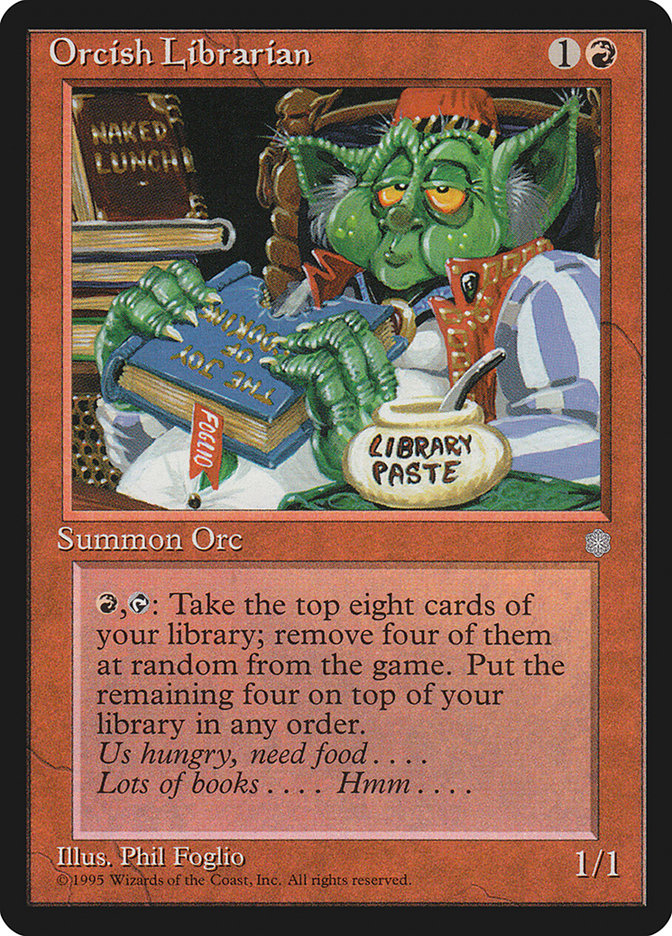
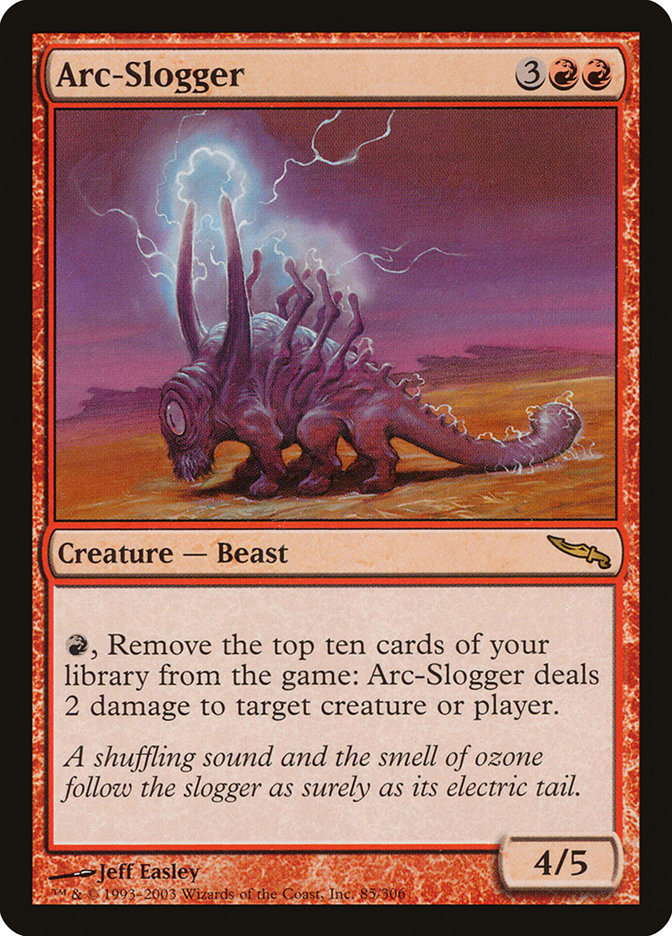
We are all very familiar with Magic's three main resources; mana, cards, and life. The fourth however we are taught to ignore and perceive as more of a rounding error in our various draw probabilities. The resource of "cards" really means "cards in hand and/or in play", those that we have immediate access to use. Those that have already been drawn or had resources spent to get them in some way. Cards however also exist in other zones and have implications as a resource in those zones. Most notably this is ones from the graveyard where they can be recurred or simply used as currency to perform another action such as escape or delve. Cards in the library also are themselves a resource of sorts. There are some cards like Arc Slogger and Orcish Librarian which directly consume the library although these are uncommon in magic, likely down to the difficulty of balancing them across formats of different deck sizes. There is also the notion that cards in library are a kind of life total. You start with some and that is all spare and good, but when you run out it is game over. We are taught that the first 19 life don't matter and that they are a resource that you should spend to get ahead and the same is essentially true of your library. So long as it never runs out too fast it is there to exploit. When not feeding ones library to an Arc Slogger you are either trying to draw a lot of cards from it to use against your opponent, or milling it into the bin because you have cards that will let you emulate card draw that way.
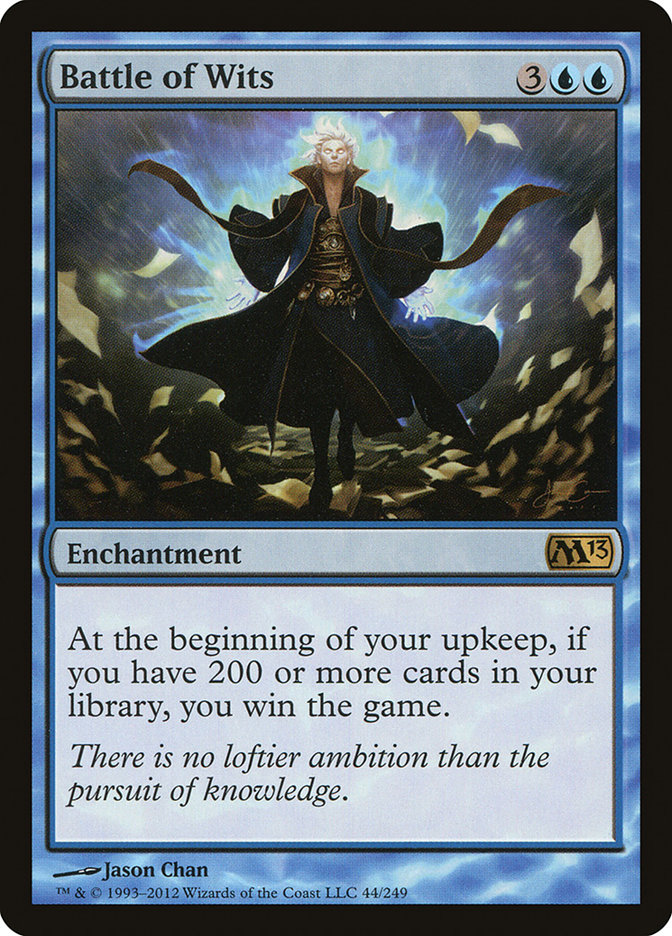
There is of course tension in considering ones library a resource. Unlike you starting life total which is set, you get to choose how large your library is. A larger library lets you draw and mill harder and longer without the danger of overdoing it and killing yourself. It also just inherently gives you the ability to play a longer game. It happens in every format I have played in, where two slow decks have a really close game and the eventual winner is the one who has taken fewer cards out of their library, be that from card draw or mill or sac lands or whatever. One deck runs out of time to kill the other. In these matchups a larger deck is typically an advantage. It was really noticeable that control builds of Yorion decks in cube would generally beat 40 card control lists simply because they could be far more liberal with their card resources. Drawing and milling more and not needing to use them once obtained for quite the same amount of return.
Now we all know it not worth making your deck over the minimum size in almost every situation because of how it negatively effects your optimal draw odds and draw consistency. We all have had it drilled into us that the smallest deck is the optimal deck and in all but the most corner of cases this is very much the case. It is however becoming less the case over time. Obviously the smaller deck sizes feel it the most. Constructed and commander have quite the buffer over those 40 card decks and are substantially less sensitive to it to the point of it being irrelevant. Fifteen card highlander on the other hand is so sensitive to it that it needs a huge helping hand with bannings and different rules for decking oneself to even be a format, and it is still a format where cards that draw more cards are typically bad! Limited magic has always been 40 card deck sizes though and that is a place where I am starting to notice the dwindlign size of my deck more and more. It is the ever increasing number of cards with more wild and wonderful abilities along with power creep and consistency creep that has resulted in more games being concerned about cards as a total quantity. Especially in cube. Hearthstone was also rather like 15 card highlander in that you tended to want cards that generated value over cards that drew more cards in your slower decks as it was just exposing yourself against slower matchups. Magic is at least very tempo focused at present and so the control decks, certainly those in cube, just fail to keep up most of the time. As such it is only really infrequently and in corner cases where we see deck size matter too much. I have had a bunch of Hogaak lists where I need to stop attacking with my Overlord or not cast a Malevolent Rumble etc because I'll deck myself before I win if I do. This tends not to be too much of a problem because the archetype can close out a game so quickly.
It is of course the homemade cube where this has become an issue I have really felt. With cards pretty even on the power level and games super tight, plenty of midrange games, let alone the control ones, have been getting decided by deck size. I have had to forcibly increase the threat and tempo of cards and toss in a bit more randomness to get games ending in good order for the health of that format. Having a player at a huge advantage because they played less card draw or had a reshuffle mechanic felt a bit of an anticlimax. Boarding in your playables just to bulk out is also something I really want to avoid being anything other than an extremely fringe tactic. I was pretty well on my way to achieving those ends but fully solved the issue by introducing combo archetypes to the mix. For real magic I don't think there is too much to worry about. There would need to be a huge swing from tempo towards value that I just can't see happening before deck size in cube, powered, combo, or otherwise, becomes problematic. If you do happen to find yourself in a rare control on control cube mirror and you do have some bulk playables in your sideboard, going up in deck size a tad is probably no bad thing. It is likely that slower self mill strategies will self limit in cube, or already have, and that will be about the extent of this aspect of the game. I do find it fascinating none the less that there is this whole resource hidden in plain sight we rarely ever consider as such (reasonable as it may be given its general relevance), however with a couple of small tweaks to the meta it can fully rear up and be a prominent and visible bottleneck effecting deck and card design alike! One can start to draw parallels between cards like Yawgmoth's Bargain and Necropotence that turn life into card advantage and Thoughtscour and Stitcher's Supplier which turn library into useable mulch, be that of escape, delve, or other flavour. I think it is good to understand library size as a resource, even if we wish to minimize it most of the time. I love how we have a game resource we set ourselves outside of the game and that comes with its own unique cost of consistency. A fully self balancing and uniquely unintuitive mechanic. We work in game to draw cards and develop mana. We are set at 20 life and work to protect some of ours while depleting all of theirs and we must do all this within the timeframe we have given ourselves based on our deck size and contents! You want better contents or more time? Mostly we don't need the latter, but it is well remembered in these terms none the less.
