Sunday, 20 October 2019

The Basic Archetypes


Faithless LootingI used to think of magic as having four distinct types of deck. Those being control, midrange, aggressive, and combo. I then would group these into two trilogies that are more like a rock paper scissors affair or like the primary colours for light and for pigment. For those who don't know, red and blue are always primary colours however the  third is yellow when dealing with pigments and green when dealing with light. Aggro is red and control is blue in this analogy. So then, if the meta has combo decks they tend to edge out the midrange builds and so you either get one or the other but rarely both as top tier contenders. You will note that in modern Jund has just started to perform a little better as the combo decks took a fairly big hit recently losing Faithless Looting to bans.

The problem with this system of  is that it doesn't quite fit the reality. Obviously there are always exceptions to any kind of nomenclature in a complex enough system such as magic. As time goes on and I find more and more of the same types of exception I am starting to view things a bit more differently. Basically I think there are two spectrum you can represent on a 2D graph. On one axis we have the transition from aggro to control via midrange. This is typically just characterized by a move from many cheaper threats to fewer higher powered ones, from less answers to more answers, from a fast goldfish to a slow one and a the corresponding mana curve increase that goes with that. All kinds of deck fit along this spectrum somewhere including the combo ones.

Splinter TwinOn the other axis we have the synergy within the deck. The combo decks obviously sit at the very top of this axis and the more generic good stuff decks right at the bottom. This gives us far better scope for understanding combo decks and the different guises they can take from the aggro combo decks just trying to do their thing as fast as possible to the more control combo decks like Splinter Twin and Scepter Chant. It also just lets us appreciate more the differences between different kinds of aggro deck etc.

So what exactly do I mean by synergy? All decks should have some but there are differing forms and they need to be a bit clearer for this understanding of archetypes to make sense and be useful. You could argue that a Lightning Bolt has synergy with a Chain Lightning as both work towards the same goal. This is not synergy in this context however. It is cohesion but that is all. The cards are on-theme with each other but beyond that they do not directly make each other better. A Monastery Swiftspear however does have synergy with the Lightning Bolt. Having Bolt makes the Swiftspear better, pretty simple stuff. This is a direct synergy and it is a good one as both cards are good and both cards are on-theme thus having suitable cohesion. It is still a fairly minor synergy however given that some two card combos win the game! Monastery Swiftspear and Soul-Scar Mage again, do not have synergy with each other directly like Chain and Bolt. They do however have an indirect synergy in that they are both supported by the same types of card. Both are empowered by a Lava Dart and so having both allows your other synergy cards to count for more and thus allows your overall list to have a higher synergy rating. This is a fairly minor kind of synergy that red good stuff aggro decks will employ to get a little more bang for their buck for a negligible cost to the build. These synergies are good because of the high stand alone power, good theming and low cost of the cards involved. They are not however powerful in that the combining of these two cards only provides a one off +1/+1 boost to one specific creature! This is a spectrum that includes Voltaic Key and Time Vault which wins the game.

Champion of the ParishAs you go further up the spectrum on synergy on this aggro end of the spectrum you hit things like humans and some other tribal decks. These push synergies a little further to get some very powerful effects. Most tribal decks are actually rather further down the speed spectrum next to midrange decks. I class a lot of the goblins decks these days, certainly the classic looking ones with Ringleader and Matron as midrange decks, just ones high up on the synergy scale. Midrange decks are typically those lowest on the synergy rating and those that are higher up often look most different from the normal expected style. Ramp decks are something that fits more into the midrange higher synergy grouping too, including Tron in modern.

Back to the aggro end and next along as we go up the synergy from tribal lists are things like affinity and Hardened Scales decks. They still operate a lot like aggressive decks but they have much more extreme things they can do as well as a lot of much weaker stand alone cards. Much beyond this point and we are at pure combo decks that are all about speed and run minimal protection and disruption. These are usually a deck with a couple of cards that work together to win the game and then the rest of the deck revolving around finding andplaying those cards. If you have a list which contains card X and card Y that win the game then they have a very high synergy rating between them but they indirectly afford a lot of synergy to cards that can find and play them for you. A Demonic Tutor has no real synergy with a Painters Servant but when you also have a Grindstone in your deck suddenly the synergy level goes nuts as Tutor becomes a high synergy card too.

Painter's ServantSo great, we can plot a deck somewhere in our 2D grid and represent the level of internal synergy it has and the operating speed it has. How is this useful? What can it do for us? I find understanding things and having them in the appropriate context in my understandings allows me to make the best choices. If I just assume a goblin deck is an aggro deck I might play it wrong as a result. I might build it wrong too. Knowing all the consequences of your actions are important. Swapping a few cards around in a build will typically shift it a bit in position on the grid. You might want to go faster to handle the meta better but you might also feel you need to have more potential power as well. This means you need to lower your curve to achieve the first goal but in order to have any chance at getting the latter goal as well you will need to increase the synergy too. This can mean that rather than just playing your best red cards you end up playing things like Thermo-Alchemist. It can mean working in a Champion of the Parish and a Thalia's Leuitenant with sufficient human support in your white weenie deck. This is often worth doing when you know you are facing a deck with something like an Ugin you just have to race but also will have to handle other faster decks that you won't beat if you are just playing Shocks and 2/1 dorks. Everything in magic is a balance and knowing how your changes affect the various scales and where you want those scales set to afford your best chances of winning are important.

Lava DartThe big key to this is synergy vs power and speed vs power. Most people appreciate speed vs. power very well. Mana curves are now entry level understanding. People are fairly comfortable with getting this balance. What people appreciate less is the trade off between power and synergy. This is because it is much more about the overall deck. The aim is to increase power but it is done by replacing good cards with less good ones which is of course rather counter intuitive. Power per mana is somewhat easy to appreciate when dealing with curve changes. Rating synergy is entirely contextual and cannot be done in any exact sort of scientific way. Sticking with the simple red examples we can get to a place where Lava Dart adds more to a list than Lightning Bolt. Obviously you are never playing the Dart and not the Bolt but there is a critical mass of prowess dorks, Young Pyromancers and Firebrand Archers where the Dart makes the deck more potent than the Bolt overall. Getting good at judging where you maximize your speed, power and synergy is basically the art of deck building. There is sadly no short cut method or magic formula. To get good at it just requires lots of practice. Build a lot of decks, play them, rebuild them but better and appreciate what changes you made and the way in which that should improve the deck.

Delver of SecretsTempo decks are the final thing I want to discuss as they still don't entirely seem to fit within my model. The best way to do so would be to wrap the speed, or X axis round into a loop. That way between aggro and control but the opposite "side" to midrange we would find the tempo lists. A tempo list tends to have aggro threats and control style answers and interaction. They are faster than midrange decks but have less threats than aggro lists and less interactive stuff than the control decks. They try and win by getting cheap, high value threats into play that they can ride to victory. Traditional control just controls until it can make serious game winning plays. Traditional aggro backs up early aggression with more aggression. Tempo is like a reverse control deck, an aggro start backed up by control rather than more aggression. They ultimately will get out valued, out powered and generally out resourced by all other builds but their tempo element keeps them competitive. They are good because they are proactive but still give you lots of choices and options. You can outplay people and you can force them into using their cards poorly because they are on the back foot. The classic example of a tempo deck is a Devler of Secrets build in Izzet with cards like Thing in the Ice and Young Pyromancer all backed up with cheap removal and counters.

Including tempo decks on our graph as described rather upsets how clean it is as it is no longer a clean simple 2D graph but neither is it a 3D graph. It is just a curving 2D one. You go on direction from aggro to control via midrange or you go via tempo as you track up the "speed" axis clockwise or anticlockwise as it were. Such a graph is nice in that decks will appear at most positions on the graph and nice in that it has relatively few elements to it while containing the important things to appreciate. It is however quite inelegant in a more mathematical sense. What might be an even better way to represent the various core archetypes to bring it more into line with graphs and math is to actually provide a Z axis term. This would be threat density as that is the main difference between tempo and midrange when it comes down to it. They might operate at rather different speeds in game but as far as goldfishing a tempo or midrange deck goes they should be similar. Tempo has quicker threats but way more dead cards in a goldfish and so the greater threat density of the midrange decks will make them tend towards a comparable goldfish speed that is quicker than control and slower than aggro. The only thing I don't like about plotting speed against threat density against synergy is simply that you find lots of areas of your 3D space pretty empty. You do not get many threat light aggro decks for example. Certainly not at the lower synergies. I also don't love giving threat density the same importance as speed or synergy. Certainly threat density is a relevant aspect of a deck but it just doesn't feel as if it is significant as speed or synergy.

Goblin GuideGetting too bogged down in a model such as this however is self defeating. This is just a good way to understand the mechanisms and directionality by which you can change decks. It is a tool for aiding understanding and by over complicating it you probably lose some convenience and utility. It is a guide to point you in the right direction. If you want to add a card to a deck you can think of how that card will move the position of your deck on the graph and in doing so which other cards will become less well suited and as such make other changes in an appropriate and informed way. It can help a lot with side boarding, allowing you to cut and add things that better position your list to combat your opponents. It helps a lot with things like cutting Goblin Guide from a lot of the tribal goblins decks that occupy the midrange or combo area at the top of the synergy axis. Goblin Guide is an aggro or tempo card and it doesn't do much to add to midrange or combo strategies beyond the goblin tag. Yes the card is good and yes it is good in a couple of tribal goblin lists, aggro ones and sometimes token go-wide ones too. It is just not an auto include across the board and that becomes far more apparent when you plot decks on a theoretical graph that represents the archetypes. It is no longer a surprise that a premium one drop goblin is getting cut from a goblin deck but more obvious that an aggro card is being cut from a midrange or combo deck.

Another thing this model does well is demonstrate quite how fluid magic is as a game and that decks are. This is obviously a lot more apparent in a singleton limited format than constructed. So much more continuous variance is viable in cube and EDH than in four copies constructed where only isolated pools of things are viable and any halfway house between most tier one decks is a total disaster of a build. For a variety of reasons you can tweak the cards in your decks to nudge your list in any direction you like on the axis. This might be to suitably house more powerful cards or to give you a better chance against the meta or even just to appease a play style. I suspect most people reading this will either think all this is pretty obvious and already intuitively understand these concepts in their own way, or they will not see the point of any of what I am on about. I certainly sympathize with anyone in the latter group. It has been hard to demonstrate exactly why this is useful. All I can do is assure you that if you continue to play the game and gain experience you will at some point find this is just one of those pieces of the jigsaw that slots into place and helps to pad out a fuller understanding of the picture. Taking that metaphor a little further this piece of the puzzle is probably one of those that is just one shade and has no relevant detail on it at all in isolation. They are both some of the trickiest bits to fit in both for jigsaw puzzles and for Magic! None the less, archetypes are a thing but they are not static or singular, they are dynamic and fluid and very much a scale. This is much the same as with almost all things humans try and force into categories so that our words can work better! It is certainly easier to understand 4 simple distinct concepts such as an aggro deck and a control deck than it is to understand the mechanisms that define all these things in a spectrum. It is indeed why I didn't even really consider "tempo" to be an archetype earlier in my magic history as I didn't really appreciate what fundamental elements defined it. It was just a type of midrange deck in my head and with this fudge I likely made a bunch of ill informed choices. So, all this has been simply to say that archetypes are not really distinct things like the colour blue but indeed shades of these things on a spectrum defined by two or more qualities.

Sunday, 13 October 2019

Top 16 Green Card Quality Cards


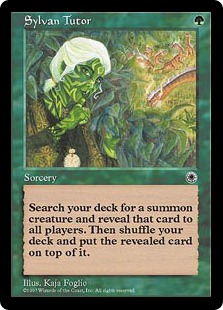
Sylvan TutorGreen card quality is something that has only really started to get a proper degree of depth to it in the last few years. For a very long time it was limited to Sylvan Library and the odd Tutor for lands or creatures. Then we started to see cards like Commune with the Wild that was not in the tutor camp exactly but neither did it offer quite the right kind of selection to appeal for most general uses. Fast forward quite some time and we start to see cards like Seek the Wilds, a tool that would find action or lands and bam, green was on the map for card quality spells. While Seek itself has never really done much in cube it marked the point at which we started to get a fairly steady flow of playable green card quality cards with some degree of power creep as well. Many of which support well enough such that new archetypes have arisen based on the power and consistency these new green tools offer.

For the purposes of this list I am only looking at the cards that are purely supporting cards. There are bigger and more powerful cards that also offer some card quality but I lump them into a different sort of camp. I want to look at the cards green uses early to help set  themselves up and increase consistency. We are looking for the equivalent Ponder and Impulse cards in green and not the Jace, the Mind Sculptor offerings. These cards are just about the card quality, they are not so interested in value or other utility. I am also really only interested in the general purpose ones. Green has a lot of creature tutor effects and land tutor effects, the best in the game on both accounts I would say. While a lot of these are great they are much narrower than cards like Ponder which can go in any old deck. Most of the green tutors are too narrow for a drafting cube. What I want to look at are the cards that can find at least two distinct types of card, ideally for two or less mana.
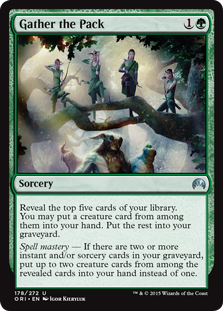
Gather the Pack
A big part of what makes some of the cards on this list potent is to do with their self mill elements which empower the many graveyard themes and synergies in cube. Due to recursion a card like Satyr Wayfinder frequently is a card that offers card selection on multiple types of card despite only finding lands by itself. The planeswalker you milled with it becomes the target of Eternal Witness next turn and your Satyr was effectively responsible for making that happen. While cards that self mill as part of being a broad multi-target card quality spell will be marked up for doing so in most cases just having mill as per the Satyr without options on types selection is not enough to qualify for this list either even if it is a more played card than most of these in cube.

Here is a list of some of the potent green card quality effects that I consider too narrow for general  (de-powered, non-combo) drafting use and as such not able to qualify for this list. There is also a bunch of cards that you could argue a case for being card quality effects even if they are a little unconventional in how they operate and offer such things to you. Most of the cards on this first list see a lot more play than the bottom half of the list proper but they only do so in constructed and combo settings.


Worldly Tutor
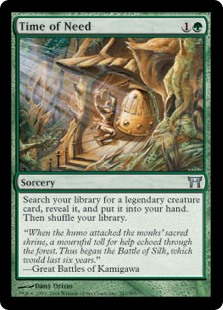
Time of NeedGreen Sun's Zenith
Chord of Calling
Natural Order
Survival of the Fittest
Season of Growth
Trail of Crumbs
Treefolk Harbinger
Time of Need
Evolution Charm
Edge of Autumn
Mirri's Guile
Evolutionary Leap
Vivien's Arcbow
Mulch
Sylvan Scrying
Crop Rotation
Summoner's Pact
Satyr Wayfinder
Gather the Pack
Tracker's Instincts

(even without access to blue this is still quite playable, if you have other spells you Gather, if you might have blue you Instincts and if you are super keen you pack both!)
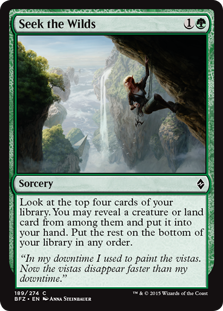


Seek the Wilds16. Seek the Wilds

As mentioned this was the first "blue" like card quality spell green got. It mirrors Impulse while also being worse on almost all fronts. Limited range, revealed information, and sorcery speed. Seek is the mark by which I compare other green card quality effects to. Worse is unplayable, better is where you want to be. Seek is about as tame as a card that is playable can be but it is simple and clean. It has been rendered unplayable by the number of better options to it now in cube, not specifically due to being a weaker card. Unlike many blue card quality effects Seek does not scale with itself in that the more copies of it or cards like it you run in a deck the weaker they all make each other. When Seek first came out two mana was still something green decks could manage to spend on a zero tempo play and not suffer for it. These days tempo is just so important that this is a much more real cost to you. Green does have access to more mana than the other colours but due to other attributes of the colour it does tend to need to use that mana to best leverage tempo proactively. A blue mage is usually more than happy to stall and when stalling you are far more able to blow your mana on things like Impulse. This means that despite Seek seeming like it might be relatively cheaper than Impulse it actually winds up as a greater cost most of the time. At least green cares a lot less about the difference between instant and sorcery on this type of an effect.
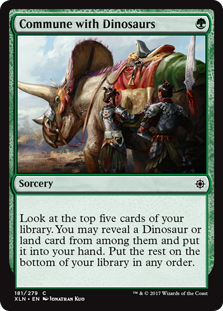

Commune with Dinosaurs15. Commune with Dinosaurs

While in reality this is too narrow for most general uses and is really just a tribal card it is still a lot more playable than Seek the Wilds. It is one mana less and looks a card deeper, the only drawback being that it needs to hit dinosaurs rather than creatures! While there are not many such cards there are a surprisingly large number of good and great ones, both in green and in other colours. Five cards deep in 40 card decks is really big as well so it is totally viable running this as a card just to find lands in a deck that is very keen on finding specific non-basics. Narrow but not as narrow as it might seem at first glance. A couple of good dinos and this can be a useful little tool you can replace a bad card with to give you better ratios and and a bit of an extra edge.
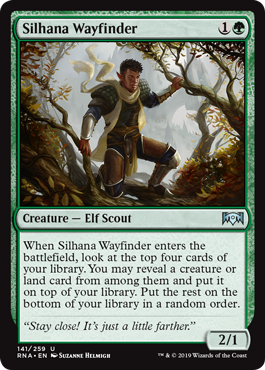


Silhana Wayfinder14. Silhana Wayfinder

This is just a Seek the Wilds that replaces the drawing of the card with a 2/1 body. In some ways that is good as it lets you increase your consistency without costing you tempo. It even has some nice synergies with things like Courser of Kruphix. Broadly however a two mana 2/1 is a bad deal. No slower decks want a card of that low power and relevance and neither do aggressive decks. That means the only time Silhana is a viable option for a card quality card is when your deck specifically scales with and utilizes creatures. Something like an Aristocrates Blood Artist deck for example. This makes it far too narrow and low powered for the drafting cube but not a card without it's uses.
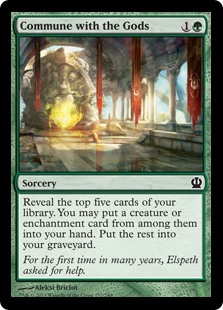


Commune with the Gods13.   Commune with the Gods

Here we have both powerful self mill elements and some actual selection. Most of the self mill cards in green hit your library for just four and only select for one card type. While not offering the most desired choice of lands or action Commune with the Gods does offer the rare ability to find enchantments which makes it just the ticket now and again. It is the most unique of the cards on this list in terms of what it offers to do. It also digs deep and fills up the bin which both help it to see a lot of play. Narrow but none the less a useful and surprisingly powerful tool. Played both when you have a lot of the targets as well as when you want the self mill.


Merfolk Branchwalker
12. Merfolk Branchwalker

This is the other end of the spectrum to Silhana Wayfinder. You get very little card quality with Branchwalker but you get generally better returns, either much more value or much more presence. A 3/2 is a lot lot more of a two drop than a 2/1. A 3/2 with scry 1 is worthwhile in some places and a 2/1 that drew you a random land from your deck is great anywhere. Scry one, or surveil one, as explore more reasonably is when not hitting a land is a low amount of card quality. It doesn't increase your consistency enough compared to other cards of the same cost and as such does not get much love for that sort of role. To want this you need to want it in 2/1 or 3/2 mode and while everyone loves the former far too few want the latter and so this card wound up really under performing in cube.
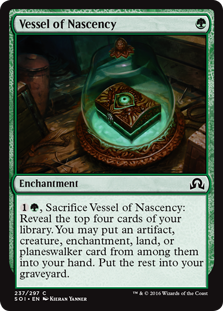


Vessel of Nascency11.   Vessel of Nascency

High nominal power but low power to cost ratio. In terms of effect this is about as it gets for green. This has the widest selection range by a long way missing only instants and sorceries. It mills. It is effectively instant. It digs fairly deep. It is also a less common type itself and can assist with enchantment synergies, devotion synergies, delirium synergies and likely some more I forget. All in all the card does a lot of work but then it would have to for a total of three mana. It is the only pure card quality spell I really ever run in cube that costs more than two, I don't even have many that cost more than one. Being able to split the cost is a big help to take the edge off the high cost of Vessel but it is still a big investment. Being able to find lands and action isn't anywhere near as important when you already have three mana. If you are stuck at two however that third land is really important. Spending all of turn one and two just to find the third land however is still a long way from optimal.
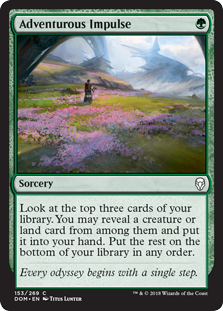


Adventurous Impulse10. Adventurous Impulse

 Adventurous Impulse is exactly on point. In the deck with only lands and creatures it is generally better than most one mana blue card quality spells. It looks three deep, lets you see all those cards right away and disposes of the rest without need of self mill or a shuffle to help with doing so. Adventurous Impulse is 50% more choice and information than Sleight of Hand and Sleight is a great little card. All round that is top notch potency for Adventurous Impulse however not many decks are only creatures and lands and so the Impulse is less potent than the blue stuff in the general case. Even with the 50% more effect than Sleight you will find that Adventurous Impulse is less good sooner than the maths would suggest (ie when your deck is a third non-creature, non-land cards). Even though on average you will see two targets when you Impulse with a deck of 2/3rds targets and thus have the same selection potential as Sleight there are several reasons why that is worse. Things like the potential to miss and the potential to put cards you need at the bottom of your deck. Ideally you want a good 75% of your deck or more as targets for Impulse. When you hit that mark you will have a good card on your hands. This worked out getting surprisingly little play in the drafting cube despite the power it has simply due to missing planeswalkers. It turns out that only hitting lands and creatures when you only go three into the deck leads to a fairly limiting card. Absolutely still a great card but not one that is able to do what you want it to quite as often as you would like. It feels really bad seeing a mana dork, a land and the planeswalker you wanted. As such this wound up getting a little less play than utility one mana cantrips in green like Abundant Growth.


9.   Living Wish
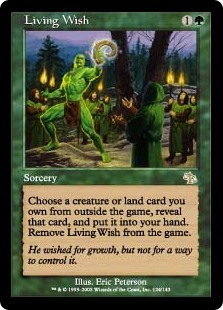
Living Wish
This is a bit of a funny one as it entirely depends on how you chose to play this in cube, which can vary further as you change the cube format. Living Wish is typically poor in booster draft and sealed events but the more you move towards constructed decks the more powerful Wish becomes. When you can pack a load of narrow tools into your sideboard and have access to them game one without any risk of drawing them and having dead cards Living Wish is a little oppressive and outclasses Demonic Tutor. It lets you find the niche things for any situation without having to fill up your deck with bad cards. Generally you will have land and some general purpose action to find with Wish and then it is decent as a card quality effect. I have done a lot of Wishing for Bone Shredder and for Uktabi Orangutan in my time! Having access to a cheap thing and late game thing is great too. Generally Wishes are a bit of a phaff including in cubes as you need to do so much admin for them. Living Wish is one of the best of the Wishes on average in the cube being so helpful for finding lands or action as required.
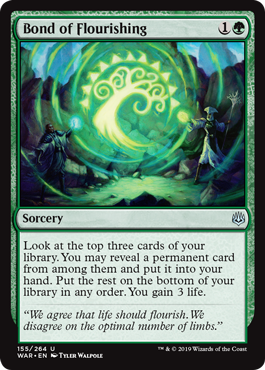


Bond of Flourishing8.   Bond of Flourishing

A bit of an oddball card. It is not a powerful card quality spell in that it only sees three deep and costs two mana for the privilege. Where this picks up a bit is that it is broader than most green options and comes with some free life. The life just helps to mitigate some of the tempo costs. It makes it very good against aggro decks where spending time on card quality hurts you. As such you don't really care that it is of little help in the slower matchups. It is still not worthless either in those matches, sometimes you can spend the life and sometimes that extra turn is all you need, even when it is the 15th! Mostly this outperforms a lot of the alternatives in cube specifically because it hits so many things. It gets land and action but it gets action regardless of your deck makeup. This finds the vehicles, the planeswalkers, the Pernicious Deeds where Seek the Wilds does not.
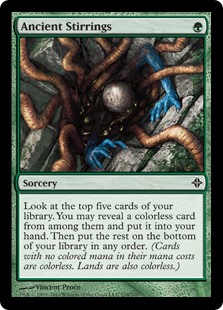


Ancient Stirrings7.   Ancient Stirrings

Only narrowness in application keeps this from being a bomb in cube. The card is so good that even at fairly sub par support levels the card remains impressive. Whenever you have an artifact, or even Eldrazi theme in your deck Stirrings instantly becomes the premium card quality card. It is self contained needing no shuffle to perform. It is card neutral. It is one mana. Mostly it is about how deep this goes into the deck. On that front it trumps Impulse. It probably should have only dug four deep, five is just so many for a one mana card. The only other cards that go that deep for one mana are much more heavily restricted like Commune with Nature. Due to lands being colourles Stirrings has that key quality of selecting between mana sources and things to spend mana on. Going five deep and hitting lands means that even with minimal targets in your deck Stirrings is still very unlikely to miss. Given that Renegade Map and other things that just find land see a bunch of play Stirrings with that as a floor is in a great position. Find a random Karn for the win is always nice too. If we were just talking constructed Stirrings would be top three on this list easily but given I am focusing on limited settings Stirrings takes a bit of a hit.
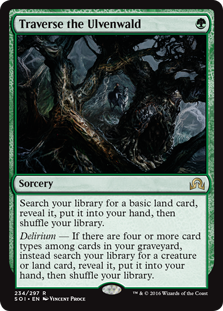


Traverse the Ulvenwald6.   Traverse the Ulvenwald

A lovely card design that winds up seeing play in a lot of builds. Baseline Lay of the Land is fine, it is a bit of fixing, a shuffle, a way of filling up the yard a bit, just a nice cheap way of thinning the deck and tinkering with your land ratios. Lay of the Land is a fine card, highly playable but not super exiting, it is never powerful or able to offer a big payoff. That is where Traverse shines. It has all the good low end playability and consistency benefits but it transforms into a it of a Demonic Tutor at some point in the game and puts  in some really good work. One mana to find any dork and put it into your hand is well below the going rate for such things. Lots of non-basic lands are well worth tutoring up too. Green makes delirium fairly easily and is typically creature heavy with a great deal of its action and utility in creature form. I am a huge fan of this card, the design of the card and how it influences deck building choices.
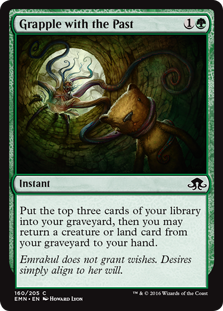


Grapple with the Past5.   Grapple with the Past

A bit of a cube gem. This card does an awful lot for most decks. As the first play it is near an Anticipate being able to find land or action as required to curve well. It is also a Mental Note in those cases filling up the yard by three cards including one instant. That can represent one of the easiest and cleanest ways to help turn on delirium early in the game. Grapple as an early play sets up your hand to curve well and have the right tools and it also primes your graveyard for however you wish to use that resource at the same time. That isn't all Grapple does by a long shot. It is one of very few card quality spells that also scales as the game goes on. Late game there is a significant Regrowth feel about Grapple. You just get back your best dork and that is lovely. It builds in some redundancy to decks which is especially desirable for synergy based ones that can lean a little harder on specific dorks than others. This is bits of all of Mental Note, Regrowth and Anticipate. It is interesting and versatile and yet still reasonably fair.
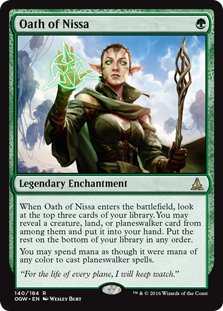


Oath of Nissa4.   Oath of Nissa

The more potent version of Adventurous Impulse. Oath has an additional type it finds making it a lot more appealing to midrange and control decks. Planeswalkers are high value targets and I would say that green decks average around three per list. That extra 7.5% or so of targets makes Oath quite a bit more playable and potent than Impulse in the average case. When you have a high % targets bar for entry into the playable realms and the powerful non-linear scaling of these cards a small 5% difference in effect results in a large % difference in potency. Oath has some other perks as well although occasionally not all are positive. Obviously fixing for planeswalkers is nice but it has only come up a couple of times with green being so good at fixing to begin with. The main difference of Oath is that it is an enchantment that sits in play. This can make it great to assist in delirium when milled but useless when it never sees the graveyard. Oath is a fantastic devotion enabler. It is great for obtaining the cities blessing and that sort of thing. Most recently it has been really annoying for my Doom Fortold lines on the other side of the board! It is less reliable and more polar however when it comes to helping with graveyard synergies. Mostly you are playing a card like this for options and consistency and in that department Oath is top notch. Between Oath and Adventurous Impulse a selection of green archetypes have had a jump in potency and a few more have passed the viability threshold. Lots of cheap card quality helps enable a lot. The cheaper and better ones like this do so the most and it makes the biggest difference to singleton formats where redundancy is such a tough thing to attain.
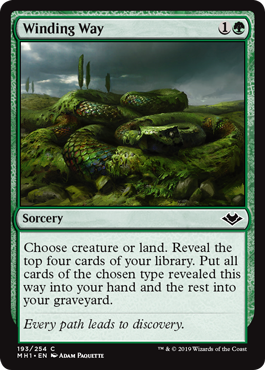


Winding Way3.   Winding Way

Another typically green card quality card in that it is a bit different. You need to make your choice before you get to see anything, and then there is no choices left and you just get what you get. Luckily this is still fine, you know when you need lands or when you need action and so all is well in the world. Winding Way is a dodgy Seek the Wilds in some respects but it has two wildly redeeming upsides. The minor one is that it helps to fill up the graveyard. The major upside is that it is frequently a two for one. The average cards it finds are certainly closest to two than anything else. Scry 2 draw 1 is a one mana card while scry 2 draw 2 is a four mana card. Seek is a two mana card and yet this is still a two mana card! All told this is a mediocre card quality spell and a good card advantage card resulting in a very good card overall. You may want to mark in down a little if you exclusively care about card quality effects. The green offerings are all so nuanced it is hard to disregard context like that for them.
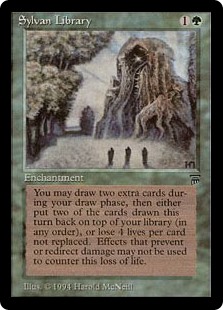


Sylvan Library2.   Sylvan Library 

The original Search for Azcanta! I did toy with the idea of having this lower on the list as in terms of card quality the Library is just an over cost Mirri's Guile. It is entirely the ability to pay four life to draw a card that pushes Library into the realms of great cards. It is not that Guile is bad, it is just not enough of a card to be worth it in most cases. Sure, a bunch of decks that really abuse the top of deck synergies will want Guile but beyond that it is not quite there. You need shuffle and/or mill effects to turn Guile into card quality and that is hard to do in an ongoing capacity. Those effects still help to make Library great but you don't have to rely on them. Sylvan Library will let you brute force your way out of a bunch of dud draws. Indeed, against any deck that is not aggressively attacking your life total Library represents a highly efficient card advantage tool on top of the selection. Or indeed just with your own life gain. Suddenly Bond of Flourishing becomes like a powered up Night's Whisper when you have the ability to pay life to draw cards. Library still is a pretty slow card. All the other cards on this list are one shot effects while Library is an ongoing one. You really need several turns with Library in play for it to shine. Further to that you do still ideally want an unthreatened life total, perhaps backed up with life gain, and both library synergy and manipulation effects. At that point it feels rather like cheating! Like having a Jace the Mind Scummer in play but for just two mana and being immune to attacks. This all probably makes it the least well designed card on this list, perhaps Stirrings takes that title. Library is a little polar but it is interesting and reasonably fair as far as good cards go on average.
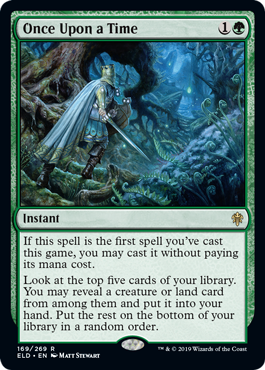

Once Upon a Time1.   Once Upon a Time

Certainly there will be times where Sylvan Library, Oath of Nissa or any of the top five or so cards on this list are superior to this but on average this is getting it done the best. It is just exactly what you want from your card quality at an impressive price. Before we even consider the free to play bit Once Upon a Time dumps all over Seek the Wilds. It does the same but at instant speed and goes one card deeper into the deck. For a card so cheap that is a pretty huge deal. Doubly so on a card that isn't assured a hit. It makes it a lot more reliable and allows you to be looser in where you can play it. In cube you draw this about a sixth or the time in your opener. This goes up a bit as well based on how much of an improvement having this is to the ability to keep a hand meaning most mulligans will occur on hands without this in them. Also the fact that you will also not make one drops and draw this turn tow or even three sometimes and get to play it for free. All told the average cost of this is closer to 1.5 mana but it is even better than that in real terms! The times it costs two will not often be a big deal but the times it cost nothing are huge. It lets you play to greens strength of gaining tempo while avoiding the weakness of green which is inconsistency. The requisit land or action split with great digging depth at the perfect price.

Friday, 4 October 2019

Throne of Eldraine: Conclusions and Additions


Well this set is just plain lovely. I don't know why I like this Brothers Grimm, Arthurian mix of mythology and lore in the Magic setting so much. I didn't expect to but it is done so well in flavour and art that I cannot help be enchanted by it all. The cards are a delight on all fronts including the all important design. When things are great at what they are designed to do but also fire on other cylinders powerfully as well it creates an overall most impressive set. I really have almost nothing bad to say about this one. It feels like Modern Horizons except that it has flavour and theme added perfectly in a way that really adds to it as well as being reasonably priced! I have already done far more draft and sealed events for Throne than I have for any set since I was playing competitively. So far it seems pretty good for limited too although it is too early to say and I am no authority on that. I have had one of the most extreme limited control decks as well as some pretty all in aggro decks which is a good sign the format is diverse and interesting.

The set doesn't even feel like it has a load of dud commons just to fill out packs and support a tried and testing booster draft meta. The commons are interesting and powerful and playable and broadly feel like they are at least uncommon. There have been a lot of recent sets where few to no commons wind up doing much of much, certainly not in the drafting cube. This set has multiple as well as a healthy chunk of strong and interesting uncommons too. I think the power level of this set hits a good sweet spot. Nothing is totally absurd (for drafting cube and probably singleton in general at least) yet lots has interest and value. Some ideas have been pushed which is always promising. I am excited to see more one mana ramp and more free spells and effects that happen without mana. I am even more excited to see the push to make more playable cards for use on turn one. Things like Merchant of the Vale are a somewhat new take on ways to make viable one drops and I am hoping to see more in the same vein. Despite my attempts to reduce the length of my reviews this has been one of the longest. I am not sure if it the interesting design, impressive power level, or just my fondness for the set that has lead to this long review. Usually when you have multiple reasonable sounding explanations like this it is a bit of each of them.


IN


Oko, Thief of Crowns
Witching Well
Gilded Goose
Foulmire Knight
Venerable Knight
Once Upon a Time
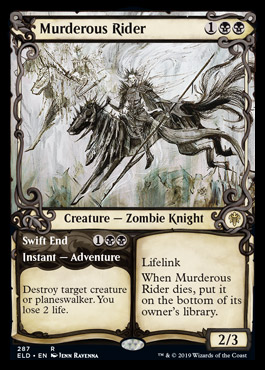
Murderous Rider
Charming Prince
Torban, Thane of Red Fell
Brazen Borrower
Fabled Passage
Thrill of Possibility


TEST (high expectations)


Vantress Gargoyle
Bonecrusher Giant
Rankle, Master of Pranks
Faerie Guidemother
Questing Beast
Embercleave
Wicked Wolf
Wildborn Preserver
Epic Downfall
Specter's Shriek
Castle Embereth
Castle Ardenvale
Castle Garenbrig
Castle Vantress
Castle Locthwain
Merchant of the Veil
The Great Henge


TEST (low expectations)


Stormfist Crusader
Garruk, Cursed Huntsman
Lovestruck Beast
Order of Midnight
Slaying Fire
The Royal Scions
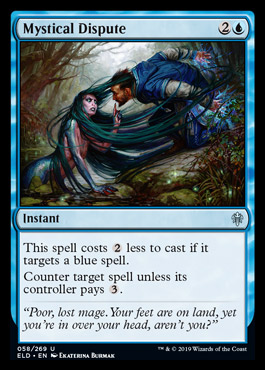
Mystical Dispute
Doom Fortold
Wishclaw Talisman
Witch's Vengeance
Giant Killer
Covetous Urge
Robber of the Rich
Claim the Firstborn
Gadwick the Wizened
Opportunistic Dragon
Idyllic Grange
Fae of Wishes
Kenrith's Transformation
So Tiny
Return of the Wildspeaker
Mystic Sanctuary
Rimrock Knight
Dawrven Mine
Crashing Drawbridge


CONSTRUCTED RESERVES


Witch's Cottage
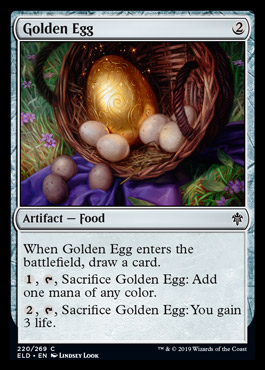
Golden Egg
Eye Collector
Tome Raider
Maraleaf Pixie
Fearie Vandal
Midnight Clock
Smitten Swordmaster
Syr Konrad, the Grim
Tournament Grounds
Embereth Sheildbreaker
Belle of the Brawl
Knight's Charge
Acclaimed Contender
The Circle of Loyalty
Worthy Knight
Blacklance Paragon
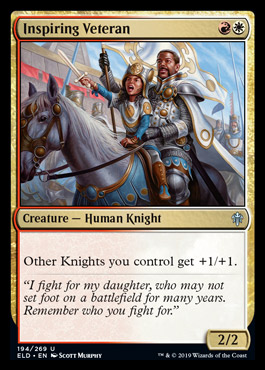
Inspiring Veteran
Wintermoor Commander
All that Glitters
Corridor Monitor
Frogify
Rosethorn Acolyte
Beanstalk Giant
Savvy Hunter
Arcanist's Owl
Witch's Oven
Alela, Artful Provocateur
Banish into Fable
Faerie Formation
Gluttonous Troll
Once and Future
Emry, Lurker of the Loch
Trail of Crumbs
Feasting Troll King
Curious Pair
Hypnotic Sprite
Ayara, First of Locthwain
Gingerbrute
Inquisitive Puppet
Fervent Champion
Cauldron Familiar
Redcap Mele
Edgewall Inkeeper
Deafening Silence
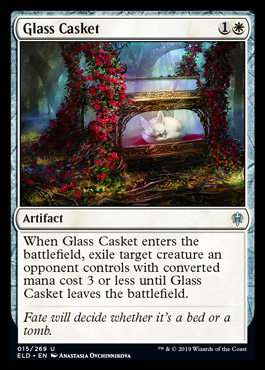
Glass Casket
Thunderous Snapper
Oathsworn Knight
Faeburrow Elder
Stonecoil Serpent
Dance of the Manse
Irencrag Feat
Mirrormade
Clockwork Servant
Fires of Invention
Bartered Cow
Giant Opportunity
Linden, Steadfast Queen
Yorvo, Lord of Garenbrig
Forever Young
Cauldron of Eternity
Overwhelmed Apprentice
Syr Faren, the Hengehammer
Lucky Clover
Gingerbread Cabin
Irencrag Pyromancer
Improbable Alliance
Mantle of Tides
Locthwain Gargoyle
Deathless Knight
Happily Ever After
Hushbringer
Merfolk Secretkeeper
Drown in the Loch
Folio of Fancies


Thursday, 3 October 2019

Throne of Eldraine Preliminary Review Part XVII


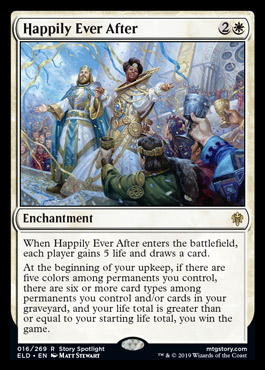
Happily Ever After 3.5

How quaint. Also, quite a bunch better than most "win the game" text cards. Having six types of card is pretty easy. Life higher than starting life total is very easy against some decks and already winning against others. It is a bit awkward as you will auto lose to aggro if you don't work on it but it will all be dead or less effective cards against control. The five life this provides helps out nicely at least. The five colours of permanent are the hardest thing to do but it is pretty easy in a deck setup to do it. Fieldmist Boarderpost, Deathrite Shaman and a Kobald gets it done pretty fast! Now spotting this counts itself you can get it done easier with the Dimir Borderpost and a Wild Cantor! You can win on the upkeep of your turn three with this I think, infact you certainly can with Leylines being a thing! I feel like this card fits nicely into a Niv-Mizzet Reborn build. That or just a five colour white deck. You have to build around it but if you do it is a pretty powerful way to win. Good flavour too.


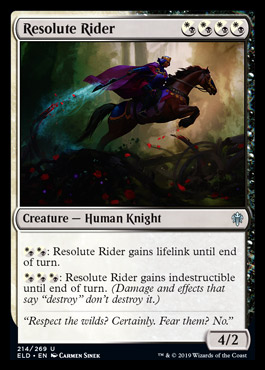
Resolute Rider 1

All the activations are just too pricey leading us to the devotion or nothing point most of this cycle exists in.


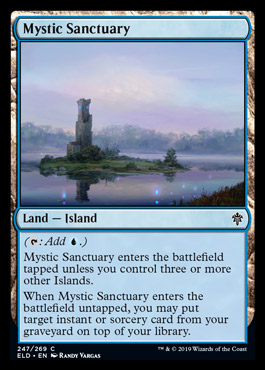
Mystic Sanctuary 6

This seems mentally good despite being essentially a copy of Witch's Hut that just works on different types. Instant and sorceries are typically more useful, powerful and synergy affording. Most of the best and most played cards are those types (when you exclude the power at least). Most of the recursion for instants and sorceries will exile the card in question. A lot also need extra mana that turn such as Snapcaster Mage. This is tutorable easily. It costs no mana when it recurs and isn't too much of a burden on your list. Just the thought of this and a pile of Time Walks in constructed is pretty scary. There are going to be a lot of different infinite turn combos you can pull off with this. Sanctuary can setup miracle cards like a dream. All round a very impressive little tool. It is pretty heavy blue and a pretty slow card what with being less than useful until at least turn four, more likely a little later. Due to being quite so demanding on the islands and how rarely decks wind up mono blue in draft I don't think this is quite there for the drafting cube. As for my singleton decks this will be all over them. I anticipate it seeing some of the most play of the utility lands winding up in so much of the combos.


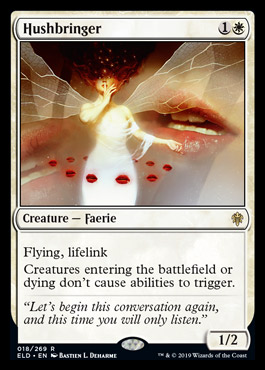
Hushbringer 4

Obviously a great sideboard card. While rather more powerful overall than Tocatli Honor Guard it is also easier to kill and you are playing these for the effect much more so than the legs and so survivability is a big deal. Still, there is Torpor Orb for that too so it is looking pretty good for Hushbringer. I don't think it is quite good enough for the drafting cube however despite the more rounded offering, these sort of random "do they get you?" cards are a little tedious both to play with and against.


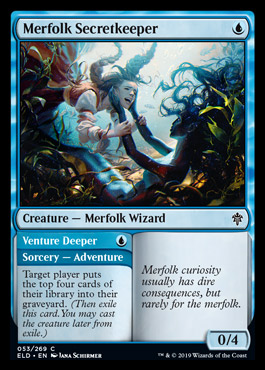
Merfolk Secret Keeper 5

Just a cheap little utility mill card. It does a bit of what Overwhelmed Apprentice does but it lets you mill yourself as well which does significantly increase the places you might want a card like this. Witch's Oven and Cauldron Familiar combos seem to quite like playing off the back of this one as an example. Calling this a Stitcher's Supplier would be very generous but it is that sort of a card. Not an exciting card but absolutely the foundations upon which you can build exciting decks. Obviously too narrow and low in power for general use.


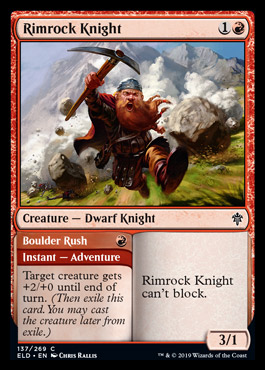
Rimrock Knight 4

This reminds me of Reckless Charge. While I do quite like this as an aggressive tool I think it is going to have a hard time lasting. It just has too many little issues across the card. A one mana combat trick and a 3 power two drop beater in one card sounds pretty nice. Sadly the adventure is on the wrong end making this near impossible to have as your two drop while gaining value from the Boulder Rush. When this loses value as a two drop curve filler the card loses value. When you don't get free pump effect the card is very low power and value which leaves this card in a quandary. The combat trick is hard to be great in that it is either just a shock to the face or it turns a chump into a trade. It very rarely saves a dork of yours. You need first strike or something for that to happen. A lot of the value of this card is that it is two spells in one. It is nothing to do with the mana costs, individually or combined they are not good value for mana or overly impressive tempo plays. The convenience of the split costs is somewhat lost if you are scrambling to get use out of both halves within the context of the game at hand. What I like most about this is that you get a spell trigger and a creature. You can run this in a Young Pyromancer list and bolster your supporting cards that make tokens without getting too light on threats. Basically this is cheap enough and offers unique support to enough that it will crop up. For the drafting cube I will give it a trail but it seems a little awkward and fair for the kind of thing you want from it.


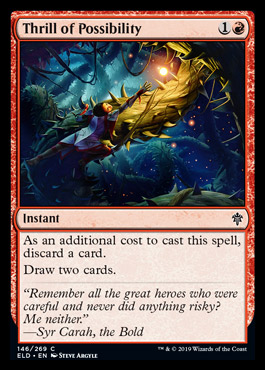
Thrill of Possibility 7

Well isn't this just a delight. Tormenting Voice was already in my cube and both Wild Guess and Cathartic Reunions, even Pirate's Pillage, were all getting love in my singleton constructed lists. This is a direct upgrade to Voice and Guess and the cleanest and most convenient of the lot. Instant makes this and whatever you are doing with it a lot safer. It is just a decent chunk better than a card that was already useful and seeing lots of play. It is like comparing Volcanic Hammer to Searing Spear! This is a new staple. It is not over powered by any means, just the best on offer for this sort of thing, which is a useful thing in plenty of places!


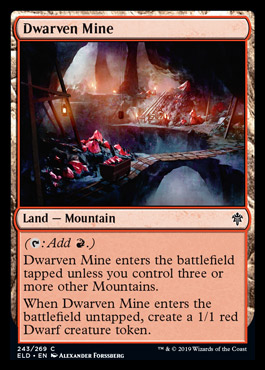
Dwarven Mine 6

How delightful, a free 1/1! Sounds minor but very much is not. Glad it isn't a goblin, might be too good for tribal lists. A token carries a lot of weight in red decks these days. They are thrown with Bombardments, they trigger Porphorus, they are pumped with things like Bushwhacker. Red is also pretty good at clearing out little chumps and so going wide gets a good amount of damage through. Most red heavy strategies are going to welcome a free 1/1. Where this falls down is like all the other utility lands in that it is only ever replacing a land, most often a mountain and as such is just adding a bit of strain into a draft. You only have so many cards and so picking playables to reach your deck limit is the priority. This has the further problem of red aggro lists often packing land light lists and not bothering to always curve to four. In those lists this will be entering tapped for too often for comfort and is unlikely to be worth it. You really need this to follow three other mountains. I keep most two land hands in my aggro red decks and this is quite the downer on such keepers. Outside of limited however I anticipate this being called upon often. I think it is less cost to the more midrange decks than Barbarian Ring and often will have more synergy and scaling in cube allowing the free 1/1 to outclass the Shock as well. One thing this does which is especially relevant for red is be a mountain and thus be eligible for sacrifice with Fireblast and Lava Dart. Not huge when all going well as you hope to have 4 mountains by then but when you are land light other utility lands really hurt those cards while this does so less.


Weapon Rack 0

Too slow and cute for cube even in a Hardened Scales setting but a lovely callback to Serrated Arrows.


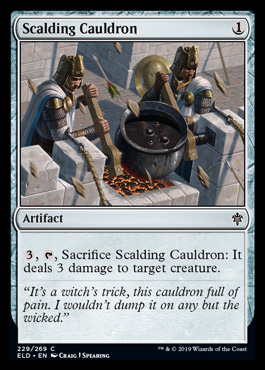
Scalding Cauldron 2

Not going to get much action but it is a cheap artifact with a reasonbly costed and highly useful ability. This is the most efficient of this group of cards by a decent margin and as such will be the go to for any deck wanting some removal utility on a cheap artifact (and where Aether and Pyrite Spellbombs are not wanted or indeed wanted in greater quantity!).


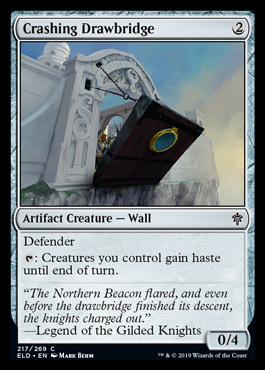
Crashing Drawbridge 6.5

This is very powerful indeed. There are not all that many ways to haste things up on the cheap. Most of the convenient all round ones come in at three. There are Greaves and things like Goblin Motivator in red that are cheaper but that only do one thing. There are symmetrical cards too that are pretty risky. This is the cheapest way you can give your whole team haste without giving anything away to your opponent. This is the cheapest way to give your things haste outside of red too. It is just safe, convenient, and efficient. It will feature rather more in commander than cube but it still seems very good for a lot of formats. It is even a 0/4 wall which isn't terrible either. Obviously the decks looking to haste things up less often need a wall, especially a tapped one but still, it is more useful than nothing, and will be great in the more combo leaning applications. Well worth testing for the drafting cube and even if it fails there I will be running it plenty constructed lists. The idea of white weenie having dorks with haste every turn is quite scary! It is an artifact and a creature so it is a little easier to kill than some enablers but you are probably OK with that in most cases as it is a cheap card that isn't directly part of the combo or a threat itself. Very impressive to see a common that is this groundbreaking and playable.


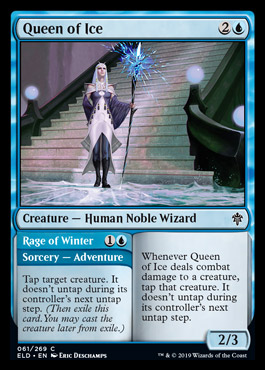
Queen of Ice 0.5

Super low powered and booster draft feeling card. Cheap, being of some use, and having potential adventure based interactions make me disinclined to fully rule this out. Incredibly unlikely to ever get into a deck however.


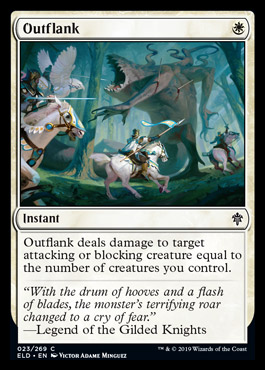
Outflank 0

Reasonable scaling but too annoying. This does nothing when you have nothing, it is always low powered in the slower and more controlling decks making it something you only look to play in aggro. In aggro you are rarely using this on attackers and as such you are probably just better off with a combat trick. This looks powerful but as you can't remove a blocker before it blocks it costs you too much tempo.


Wednesday, 2 October 2019

Throne of Eldraine Preliminary Review Part XVI


Gingerbread Cabin 4

A bit of a Khalni Garden in food form. Two for one permanent making lands have proved potent although this needing to be the 4th forest does reduce the potential abuses for such things. An easily tutorable land with 3 life on offer is a pretty nice thing to have even without any synergies. This should see a bunch of play ranging from ways to hose aggro decks, ways to empower sac outlets, and I am sure many many more. Too narrow and low power for a slot in the drafting cube but a land I expect to be showing up rather a lot in constructed singleton lists.


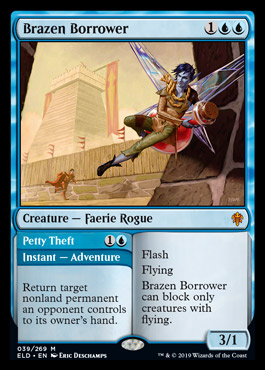
Brazen Borrower 7

Clearly an impressively rounded card packing a lot of power. A chunk better than Nimble Obstructionist but probably not quite as strong as the mighty Clique. Borrower is exceptional planeswalker control as are most of the flash fliers. You will however find that it will deal with a lot less walkers if it goes on an adventure any turns prior to playing it. This in turn means this is either rather more of a five drop or a 3 drop without the adventure if played as the more controlling player. As a tempo card you can more happily just curve out both parts with this and that will be fine. Due to the low cost of this as a bounce spell you will just fire it off almost anytime you have spare mana and a reasonable target a bit like a Remand. Just a bit of stalling. Overall the mana cost on this card isn't all that impressive. It is one shy of a Dream Eater for a lot less overall card. Venser is closer in power and he costs a mana less and bounces things rather better. What Borrower brings to the party is flexibility being a two drop, a three drop, both if you want it, and fairly often a five drop too for that vast felxibility. It is all instant speed making it great disruption and highly convenient for any archetype. Not the most exciting card to look at but the kind of card that will lead to interesting games and plays. Why it is a mythic I have no idea, I am sure this should be swapped with the Wish faerie...


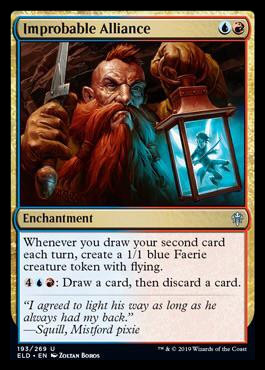
Improbable Alliance 4

As a build around I think this has a fair amount of potential. If you build to support it which a lot of Izzet tempo decks naturally do anyway it will be nutty good. Compared to Bitterblossom you can have faeries quicker, and then at twice the rate without any life cost. You even get a silly loot should the game somehow go that long with all your dorks. Much better in a lot of ways than Young Pyromancer, the tokens fly, and enchantments are a lot harder to remove than 2/1s are. Pyromancer does have an easier time of making the dorks but still, I am a fan of this and will be playing it a bunch. The main issue it has is a reliance on a specific few cards that can cheaply draw two at instant speed. That and Gitaxian Probe for the dream turn two play. If you also want Gush and Brainstorm and the like it starts to get very demanding on your picks. The ceiling is great and the average should also be good if built with properly but it does have the issue of being a card that does nothing of much use by itself. Too much support for a gold card to have any hope in the drafting cube but otherwise I expect this to do very well.


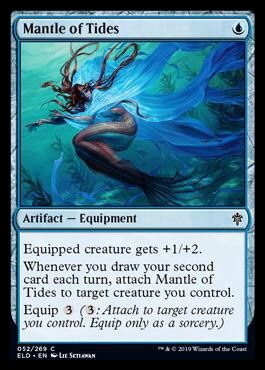
Mantle of Tides 3

A rare example of a cheap blue tempo card. This is really surprisingly good. Turn one this, turn two Fblthp the Lost and bam, a 2/3! This turns something like a Looter il-Kor from an annoyance into an urgent danger. While the ability to get ongoing buffs to your dorks for no mana is decent what really pushes this is the combat trick aspect of it. You can attack with your whole team and your opponent has to block as if anything can get +1/+2 at the drop of a hat. Anything such as an Opt is now a combat trick. A Divining Top in play allows you to re-equip at instant speed and no mana cost. Blue doesn't really do aggro that much in the drafting cube and this is still probably a little narrow for such things but it should see a bunch of play in more focused lists. This is a low cost, low risk, card with decent tempo, synergy support and options all going for it.


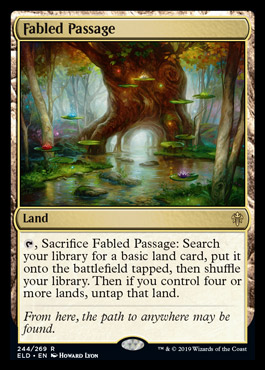
Fabled Passage 8

Another take on Prismatic Vista. This is generally a little worse as you are really looking to make other lands for your first three drops. This means that even if you have three other lands you can't use this for a free shuffle or fixing until they have been laid. Still, most control and midrange decks will be reasonably OK with that. Extra fixing and the like is always welcome. It will probably still see play in a lot of aggro decks too as they really like fixing. Sometimes they don't even get a fetchable dual land in their colours at which point this looks like the third best sac land they can play. Much as this is the weakest of the 12 sac lands I will have in cube it is a very welcome addition. They are the most played cards and they are arguably overly powerful. This eases the strain on them and helps support things that want stuff in the bin or shuffles for the deck. I really like how this plays so differently to the other saclands as well being the only one that is painless but also one that you have to consider heavily how you will play and what you will get when you crack it.


Kenrith's Transformation 5

This seems really good but it also seems like it is probably too situational to get much play. The ability to upgrade a crap dork of your own or scale back a bomb of your opponents for just two mana seems great. If used as removal you are not even that much at risk of failing to draw your card as that would require the opponent to sac their big threat off and forgo getting it back or having a 3/3. Turn one Clockwork Beetle, turn two Transformation and in for 5! There are some cute things you can do with this that is for sure. I really like it. The cost is low being zero in cards and only two in mana. It is both a buff and a removal spell of sorts too. Green is desperate for disruptive removal and any playable card with options is nice. All told I am still not entirely sure where I play this or exactly what I am doing with it. A card I will test out for sure but I wouldn't be at all shocked if it wound up doing fairly little in cube.


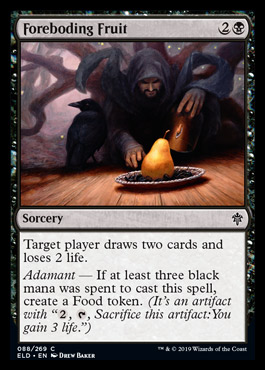
Foreboding Fruit 2

A decent card but a little too demanding on the food trigger and just too much worse in general than Night's Whisper or Read the Bones.


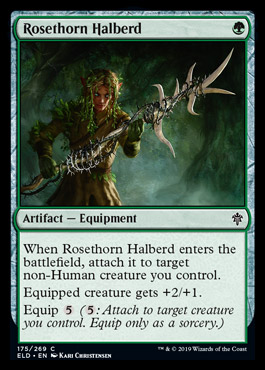
Rosethorn Halberd 1

This is a decent low risk ongoing buff for the initial cost but sadly the re-equip cost is prohibitive. At 3 it would have been reasonable and might have had some play in aggressive green decks alongside things such as Rancor. As it stands it is just a bit of a poor aura. Who cares if it survives having your creature removed if you can never re-equip it? It might get a tiny bit of action based on being an artifact and not an enchantment but that sounds like a very deep deck, and not a good one at that.


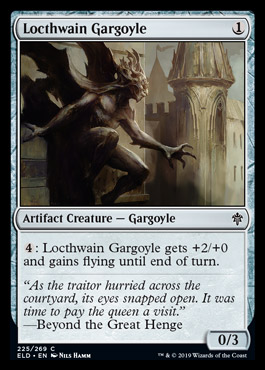
Locthwain Gargoyle 2

Cheap, decent stats, decent potential. This can hold the ground early, threaten the odd walker in the midgame, add to artifact synergies and then be a win condition with infinite mana! All a bit magic cloud land. A lot of the time this is a Wall of Wood. Not often worth the card cost! You have to really want a lot of what this offers to be playing it. The activation cost to make it relevant is just so expensive it prohibits normal use. Still a lot of card for the mana and a fairly wide range on potential homes.


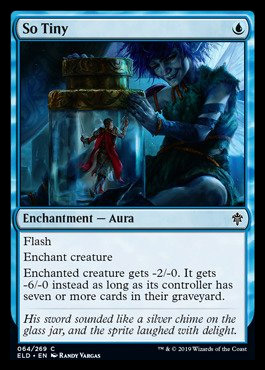
So Tiny 3

Now this is a card with the right price and speed. It is very soft removal in that it only really deals with things looking to attack rather than things with ongoing effects, activated abilities, EtBs or other such delights. That makes it rather weaker compared to other one mana removal but none the less pretty good compared to other blue "removal" options. The scaling on this allows it to deal with early threats and potentially even big late ones. In the right situation it will act as a combat trick and turn a poor trade into a chump. Great for saving planeswalkers too. Sadly I think it is a little too low powered and situational to last, blue will either play removal from other colours or make do with bounce, counter and steal effects instead resulting in this seeing too little play. It does still seem like the best card in this category of giving a permanent -X/-0 debuff.


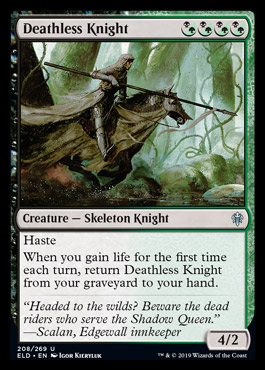
Deathless Knight 2

Quite an easy recursion target and as such something you are fairly happy just running into things and trading with. Four power with haste is reasonable, it isn't great but it is action right away which is what you want mostly. This turns out to be one of the better ones from this cycle. It is not a tempo play really despite the haste and aggressive statting just because it is fairly low powered at four mana. It is much more of a value card which does ultimately make it a little off theme with itself. Not entirely sure where I would play this but it probably will have a home somewhere. There is just too much this card does and too many unique elements to it for it not to see play somewhere.


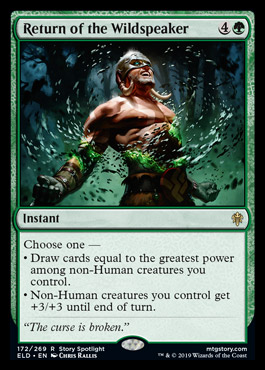
Return of the Wildspeaker 4

This seems pretty potent. It is an instant Overrun that also has alternate utility. While it doesn't give trample or work on humans that is mostly OK, green has the least humans and instant is broadly rather better than trample. This is either a powerful finisher or a blowout combat trick that will be hard to recover from. It is also a much better version of Soul's Majesty that is harder to get disrupted with lack of targeting and being instant. Both modes do need dorks but in very different forms and settings. While this does seem powerful and flexible I think I would still just rather run a threat that can win a game or that provides value or both. That includes most of the good walkers and some of the better creatures. The decks that are taller and work best with the draw tend to not be the best houses for Overrun effects either so this is rarely a perfect fit. Powerful and versatile but not really what I am looking for in a cube setting.