Mishra's Factory is pretty iconic. It was the first card to do what it does and remains remarkably reasonable at doing it. A kind of benchmark for what a manland or creature land can or should be. What is most remarkable to me is quite how viable this card has remained over the years. This is especially the case given that creatures are the main focus of power creep over the years. A Grisly Bear might have not been laughable in the nineties but in more recent times such things don't hold much water. How is the simple notion of being able to hide as a land able to transform a 2/2 vanilla dork into a relevant asset? And perhaps more vexingly, how has this first iteration manage to keep up with newer cards that hide better dorks or offer better lands?
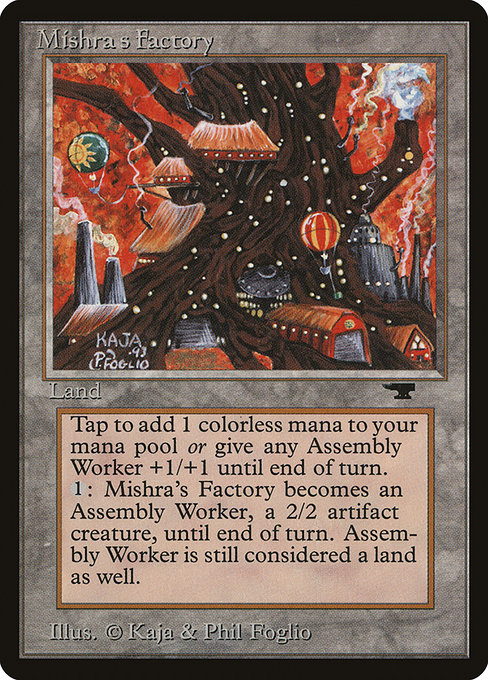
The strength of the land one can animate is well appreciated. Land is pretty hard to interact with affording you a safe place to keep a threat. Having a mana sink on a land is a great pairing of early and late complimentary utility pairings. It is a very low cost inclusion to a deck letting you cram in extra value to you deck.
Aggro decks of old couldn't pass up on those resilient extra threats and the control decks couldn't pass up on the free value on mana sources. Magic in the early years was rife with the Factory. Then after 5th Edition I think it was they stopped printing it for a while and we got a smattering of other animatable lands to play with from the Treetop Village cycle to Blinkmoth Nexus to Mutavault and eventually the duals in the first Zendikar, upon finishing and adding to that style of cycle we are now beyond spoiled for choice on lands that can attack. All of these historic cards were good and all got play, and all of the newer ones would have if they came before the glut, however none have properly unseated Mishra's Factory. Throughout that period the Factory has mostly been in the cube and been getting enough play and activations to be a worthwhile inclusion.
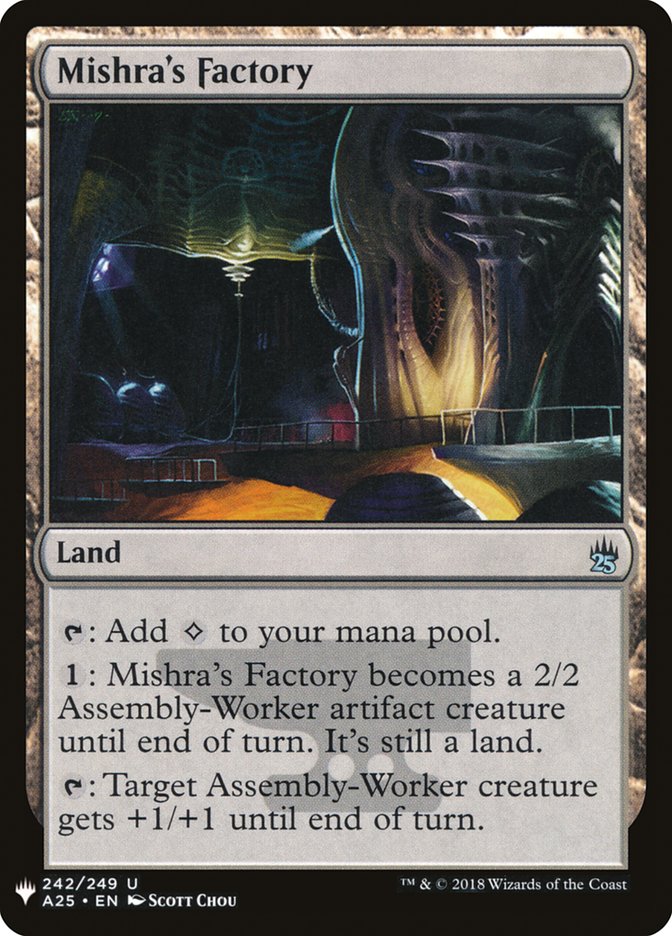
A couple of factors are I think at play helping the Factory to compete in a world of ever increasing creature power and utility land variety. The introduction of planeswalkers helped to increase the relevance of anything you could do to boost an attack with on an immediate basis. Simply having a land sat in play you can animate greatly changes an opponents ability to deploy a planeswalker. This applies to all manlands as well as creatures with haste and things like vehicles. What specifically about Factory lets it still compete in this wide field? Simply put, it is the cheapest on offer. On all fronts. All colours can play it. It is a single mana to animate and there is no tempo cost to deploying the Factory, it comes in untapped. Assuming you can stomach the colourless mana it has no other real cost.
You then only have to pay an effective two (colourless) mana to get in two extra power of attack at any future attack. Not only is that one of the cheapest you can get an attack in with a land but it is also still one of the most efficient damage output per mana invested. The strength of the land that attacks is being able to attack when needed and do so efficiently and Factory is still absolutely one of the best in the business for that. It isn't so much about sustained threat, it is about being able to have that extra couple of point of damage or have that extra body to go wide with on that key turn. No utility land is efficient when activated over and over again, it is about being able to do so when it matters and Factory is just a card that is there for you more than most. Sure, Mutavault has those same key traits and is a very comparable card but artifact synergy in cube has been vastly more relevant in cube than tribal synergy. We haven't even touched on the 3rd ability that Mishra's Factory has. It is the least relevant of the three but it is still a good one, and enough to carry it about Mutavault by itself, even in singleton. Factory can pump itself to block as a 3/3 when not summoning sick, or it can use a cheeky untap effect to attack harder or be a surprise combat trick. It can even pump Mutavault if it really wants to rub it in!
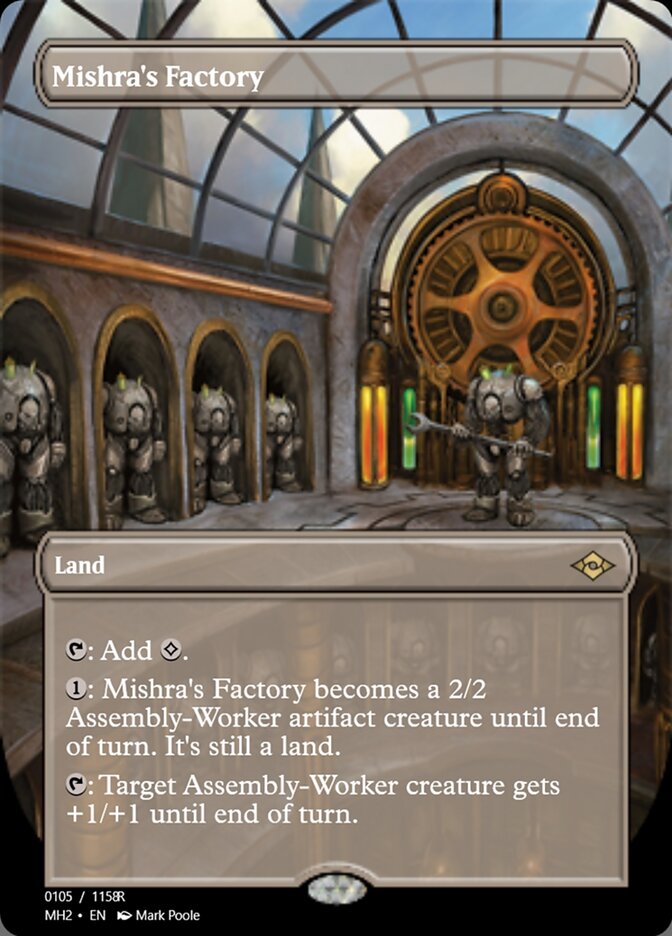
Over the years I have done a lot of cube style constructed events too, usually epic rotisserie affairs allowing any cards to be picked. Suffice it to say I have played a lot of 40 card singleton affinity decks. Yes, the flying on Inkmoth and Blinkmoth Nexus make them the best utility lands in the deck. But no, that doesn't take away too much from the fact that Factory is still a really top rate card in that archetype. Able to turn on and power things up without attacking, able to hold modular counters like a legend, or just be another piece of sacrificial fodder. Hard to go wrong with Factory in affinity. Not many other cards have played alongside Cranial Plating and Arcbound Ravager on the one hand and Counterspell and Wrath of God on the other!
Few cards have such a historied resume, let alone such a broad, diverse, and active one. Yes, in the early years you could make a case that the card was over powered. But then, lots of cards were. And you could equally make the case that creatures were underpowered in 1994 and the power level pegging of Factory was pretty on point for a mover averaged notion of power level across magic. Indeed that is how I view things and in that light you find one of the very best designed cards of all time. A card that is playable in multiple different archetypes and formats over multiple decades is already an impressive feat. Doing all that without ever really being that oppressive or broken elevates you to a pretty special tier of card. As far as design accolades can get, I think few can be more deserving than Factory. It is very likely up there in the leader boards of cards I have won or effectively won games because of as well, not because of power but because of that seemingly omnipresent quality it has, just there to tip the scales in your favour.

No comments:
Post a Comment