Monday, 6 April 2020

Ikoria, Lair of Behemoths Preliminary Review Part II


Gyruda, Doom of Depths 2

Only even cards is a big ask. Too much for a limited deck in most cases which makes this not much of a companion in cubes. It is not unplayable without companion but a little unreliable. The six mana 6/6 is OK and the Reanimate effect on top of that is great. Sadly limiting it to a fairly random set of 8 cards and only even dorks makes it too random to be worth it. This will outclass The Scarab God more than you would expect but it will be a Craw Wurm far too often thus making the average far far lower than that of the God.


Lutri, the Spellchaser 9

This might be too much for cube. All this costs to play is the cost of picking it, which may be nothing in a sealed deck. A 3/2 flash you just get for free is good. Really good. Better than Rogue Refiner by a pretty big margin when you are not in the market for energy. Lets just reiterate that incase the significane has not sunk in. The floor on this card is a significant amount higher than that of a Rogue Refiner which is itself a very strong card. If Lutri copies a burn spell or something like a Ponder then the card is a joke. This would be close to enough without the companion mode due to the power of the fork and the passable floor of easily cast 3/2 with flash. Being a free card you can just have is absurd. Much like for EDH, this might just need banning in cube. It is also in the colours least in need of a big generic boost like Lutri affords. A green white dork you got for free might have been a needed help to struggling colours... oops. I think I have only rated two non-land cards as 9/10 since Deathrite Shaman. They both cost 0 mana. Force of Negation and Once Upon a Time. That is the level of silly we are talking here in singleton land.


Void Beckoner 0

Just to expensive on all accounts. I like the design but it is not for cube.


Vadrok, Apex of Thunder 6.5

The floor on this is a bad Mantis Rider and while that card is good it really needs to be for a triple colour card. The floor here with Vadrok is well below par what with being three colours too. Luckily the mutate is rather spicier. It drops the colours down to two which is a big deal. The hybrid makes it less narrow than a typical two colour gold card too. It potentially lets you attack with flying right away making it reasonable at planeswalker control. Really it is all about that mutate trigger though. Recasting any non-creature at 3 CMC or less is amazing. It can reduce the effective cost of this card down to 1. Vadrok is part Snapcaster Mage and part Bloodbraid Elf. Even just getting back a Lightning Bolt or Ponder is going to be pretty great. Assuming you can consistently mutate and onto a creature no bigger than a 2/2 Vadrok is in the same league as Snapcaster and Bloodbraid. If however you cannot then the value falls away quickly. I expect that it will be tough to always have a target but not too hard to engineer one. There are a lot of humans in these colours and the kinds of deck looking to recast non-creature spells from the bin is not the kind of deck that has lots of creatures to mutate onto! I suspect that Vadrok will wind up being reasonably middle of the curve (as per the cube, so average of the really good cards) when all is said and done. When he works the power will be impressive but the slight conditional and narrow parts of his design shall keep the overall down. It might even be polar enough to cut. Make no mistake though, when this works it will do so in brutal ways. You can go from having a 1/1 in play and facing down planeswalkers, blockers and threats to facing nothing and having a relevant card in play.


Pollywog Symbiote 1

Despite both being English speaking this translates poorly in the UK. This makes me think of questionable children's toys  and jam logos, not tadpoles. Whoopsie. A nice little mutate enabler for such things but as ever, narrow set mechanics don't occupy enough slots in cubes for cards like this to come close to worth it.  I'll build the mutate deck at some point, it will be fun and well below par. This will probably be in said deck and that will likely be the one time I play it in singleton.


Umori, the Collector 2

Less limiting than those with CMC restrictions but also rather less payoff. A 4/5 for 4 is OK and certainly a lot better for no card cost but it is still way worse than Lutri both at floor level. Vanilla stats scale poorly as you go up in CMC. Cost reduction is nice but the more expensive the thing it is on the less exciting it is. Umori might help ramp a six drop out but it is worlds worse than any ramp you get online turns one or two. I would almost just rather have trample or something. Prior to adventures I would pretty much have written this off. Much as there are loads of decks you want a lot of dorks in those few non creature cards tend to be the most important cards. An all creatures deck is going to be lacking in several areas. You might be able to do an all artifact deck that makes use of Umori in constructed but creatures is the only thing this is working with in cube. Even in the constructed setting it doesn't sound all that exciting. You have cost reducers a plenty at less than four mana.
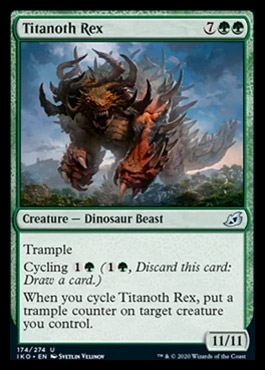


Titanoth Rex 1

Cute design, bit bland, fair and clumsy for cube.


Snapdax, Apex of the Hunt 5

Much as a 3/5 doublestrike for 4 is quite scary it is just a dork and three colours, either of which pretty much rule it out for cube potential. The floor on this is too low, even though it is still quite powerful. The mutate gets scary however. You can clear out blockers and attack with a hasting doublestrike dork. Potentially one with more than three power and extra evasive things going on. Snapdax has some potential to be like an Embercleave. I think that it has slightly less chance than Vadrok of lasting in the cube. It has all the same issues while also being pricier and in less appealing colours. It still has quite a wide range where it could be a cube bomb or dud. My guess is towards the dud end as conditional cards generally tend but having no experience with the mechanic as yet I don't feel comfortable making that call!


Gemrazer 6.5

A four mana 4/4 trample reach is not a good floor but it is fine. The key words make it useful in a couple of places. The mutate is nice though. Green is easily the most reliable colour to mutate into with most non-human dorks as well as the most dorks. Gemrazer offers some utility in removal as well as some potential to augment with useful stats or buff up a weenie making it quite versatile. Gemrazer can add trample, it can add +3/+3 to  an attacker. It can be a Naturalize or it can just be a decent dork. That is all a lot of utility without too much in the way of concessions on power or tempo. I think this has a shot in cube over cards like Thrashing Brontodon. This is a more relevant body, has more utility, and isn't a massive cost to use as removal. It may just be worse than a cycling Naturalize, Acidic Slime etc. though. As with many of these close call mutate cards, really it needs testing.


Grimdancer 3

Decent amount of power and good flexibility. Much as I like this a lot in principle it feels like it winds up being just a dork too much of the time. I want real threat levels of some assured value with my cards three and up on mana.


Sprite Dragon 7
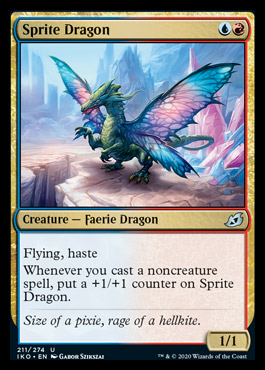
This seems a little narrow but foolishly powerful. While being both gold and prowess themed should make it doubly narrow it just so happens that prowess is the main thing this particular set of gold does. As such this is still in the playable range of narrow for cube. This is basically a Stormchaser Mage that trades a small amount of early survivability for a vast swathe of potency a little after. This can end games so quickly. You can go this on turn two, Bauble, Bauble, Gitaxian Probe and in for four. Then untap and throw three burns spells at face, in for another seven with this and likely have that be game there and then. This gets so threatening so fast, you can lay it in the mid game and have it be relevant immediately with some follow up. You can just lay it turn two and force an answer else your opponent is risking it getting too big to handle immediately on the following turn. You need to respect this and it really doesn't need much support to make it worth playing. Quite a scary little beater.


Brokkos, Apex of Forever 2

A recursive fatty! The issue I have with Brokkos is that he is more of a three colour card. You need to get him in the bin before you can play him for two colours of mana. Sure, you can loot or mill him there but those extra restrictions or the extra colours massively take away from the cube playability of Brokkos. Then he fails the just a dork test. Pretty easy to handle. He is only really a scary card in grindy games where most things are going on in combat. I can't see Brokkos making it, it doesn't even look great for themed decks setup to best use Brokkos.


Crystal Giant 1

Quite a lot of card for the mana but slow, inconsistently what you need, and ultimately just a dork that dies to a lot of removal in the unlikely even that it is of high importance this needs dealing with.


Sunday, 5 April 2020

Ikoria, Lair of Behemoths Preliminary Review Part I


Huntmaster Liger 0

Too expensive, vanilla and fiddly. You need things to line up a bit too well for this to do enough.


Keruga, the Macrosage 0

This might be one of the worst cards of all time! At least in companion mode it is. The notion of a deck with no 1 or 2 drops is comically bad in any competitive format. You don't get a big Living End win payoff either, just a couple of cards and a vanilla dork. Bleh. Not enough for a deck slot and absolute suicide to use as a companion. Scary new mechanic at least. Both in the sense that companion is mechanically awkward to check in real games and in that it is powerful having access to an extra card in your hand. Commanders for normal magic basically.


Illuna, Apex of Wishes 5

Mutate is pretty fascinating as a mechanic as it has so many different things at play. I considered just doing an article on the mechanic itself as a sort of grounding exercise but it seemed a little foolish to do so without having played with it yet. One thing I am fairly confident of is that we will not see much if any mutations onto creatures with mutate in cube. That means Illuna is getting one shot at the trigger at best, less on average with targets getting killed in response or just not having anything to mutate onto. So, the floor of this is a 6/6 trample for 5. Powerful in principle but just a dork and in three colours making it appalling. Does the option on the mutate make up for that? Possibly but probably not I would say. Just all a bit expensive, fiddly and unpredictable. Mutate can give effective haste which is one of the best things about it for Illuna. The trigger has a high ceiling, ideally say flipping over a big planeswalker. It can also just find some mana dork, or perhaps a threat you don't wish to lay as it is an over extension. Without setup the mutate feels like it is going to equate to little better than draw a card. So, is 6 mana in two colours and say a 1/1 token for a 6/6 flying trample haste and a card good? Well, it is better than the normal mode but it still doesn't feel bomb like given the hoops we are jumping through. Worth a test I would say but expectation is pretty low. Illuna rarely poses a serious problem and that is what you want your big cards to do.


Lukka, Coppercoat Outcast 6

This seems very strong but a little at odds with itself as well. The best use of the -2 does not work well with the +1. The best use of the -2 seems like it is just a Polymorph effect which you can use in a deck with dorks. Play only one, two, or whatever drop dorks are appropriate and then a couple of fatties. That way you can fairly consistently just cheat out a massive dork for five mana. A modern deck full of Jace, Vryn's Prodigy, Snapcaster, Dreadhorde Arcanist and then Lukka plus Emrakul sounds fairly real. The +1 certainly helps you find these fodder cheap dorks but it is a combo deck and will likely run fewer dorks than aggro and even most midrange decks I suspect. When you are hitting one or fewer dorks on average on the +1 it is fairly lame, you really want it closer to an average of two hits. Even so, a fine enough value ability you can scale. A little awkward in that it actually has a pretty real cost in 40 card decks, you can't just sit there pressing it and growing Lukka as you will mill yourself out very quickly. This means Lukka needs that -2 to put in work, you can't just run him as a source of card advantage with a dash of utility and reach. I think the -2 can be used well outside of combo. A little like you use a Birthing Pod or Recurring Nightmare. A range of dorks across the curve with good EtB effects. In a well built deck for Lukka you should be able to sac off a couple of dorks in play and aim at hitting the effects you want with a good deal more precision that you might expect. While I will certainly be trying this out as it is so fun, interesting and different I suspect it is not going to last. Red has insane 5 drops and Lukka has two big failings. One, no self protection. You can't even be reliably aggressive with it such that it isn't a problem. That is what makes Chandra, Fire Artisan such a strong card. The second failing of Lukka is that he scales so much with deck composition that he is effectively quite a narrow card I think. Despite looking like not being great for limited cube I think this guy will see plenty of action in many constructed formats. I am certainly looking forward to trying him in cube too.


Vivien, Monster's Advocate 6.5

Well this does a lot of things and it does them well. Those things are all roughly the same in that they gain you value in the form of putting dorks into play at zero card and often reduced mana. Much as I like my walkers to have diverse abilities I am OK with the samey ones on this as they all work towards winning the game well and do have differing applications. Making 3/3 tokens isn't broken but it is decent, the ability to tune them a little is really useful too. Protection against fliers is lovely for a walker to have. The -2 is very potent in some settings, it is tutoring and both card and mana advantage (unless finding 0 CMC dorks!). It has some combo applications with the tutor side even if it is fairly slow for such things. It might be a bit overkill with all the other abilities going on but it is nice utility to have. The library shuffle could even be a valid use! The only other thing you are using loyalty for is safety . So how good is Vizier of the Menagerie on a planeswalker rather than a 3/4? Certainly a lot better. It doesn't lead to over extensions when working or basically just be an awful Hill Giant like card when not working. It is just reasonable value. Not as good as Oracle of Mul Daya or Mystic Forge in the artifact decks but still a nice way to generate card advantage. You will wind up taking some weaker lines, less tempo, less mana efficient, etc, just to cast things off the top rather than from hand. I think this is a lot better than Garruk, Primal Hunter and better than Nissa, Vital Force (who is the weakest walker in my cube in this slot). That should mean it gets a slot but all told Vital Force probably shouldn't so perhaps this will get the cull before too long. Solid card regardless. Relatively low starting loyalty is a mild concern but 3/3 reach dorks should help out reasonably well with that!


Zilortha, Strength Incarnate (Godzilla apparently) 2

An inverted Doran than turns X/Y dorks into effectively X/X dorks rather than Doran who makes them Y/Y, for combat and normal damage at least. You can still kill Zilortha with a Toxic Deluge for 3 but for most other things he is just a 7/7. There are probably plenty of abuses for a low toughness dork that is actually massive. While this is cute the idea of running loads of how power low toughness dorks to go with it seems terrible. Even if you had this as your commander it isn't always going to be around. A 7/7 for 5, even with trample is not very exciting. It is slow and far up the curve and gold. Bleh.


Luminous Broodmoth 6

This is a bit like Nightmare Shepherd and probably better. It doesn't exile your stuff and returns things generally better with flying rather than stats reduced to 1/1. Black however does have more to do with sacrificing stuff and more EtB trigger dorks which scale really well with this kind of effect. I am not sure where the Broodmoth fits in. White has far better aggressive plays it can make like Sublime Archangel. This might be OK against mass removal but against spot removal it is a massive fail. You want such things on cheaper, less relevant bodies. See Selfless spirit. Broodmoth is a strong card and worth testing but I expect not making the cut with so many outstanding white four mana planeswalkers on offer.


Zagoth Mamba 2

A nice cute little mutate enabler that has no chance in cube with a low floor and no where near enough support for the synergies. I can see this being run in a themed constructed deck but that is it.


Drannith Stinger 4

Not enough card for the drafting cube despite being cheap and flexible. This will shine in Ikoria booster draft. It will also be great as a potential win condition in some combo decks. Pretty easy to win on turn 3 with this and a Fluctuator. Pretty easy to find this too in a deck built around Fluctuator! We are probably not all that far off a reasonable synergy deck using cycling in an aggressive way which will be another home for this card outside of the limited settings.


Cloudpiercer 0

Far to expensive for just a bit of looting. Beyond that this is just a dork. Even supporting mutate synergies this isn't cutting it.


Saturday, 28 March 2020

Thass's Oracle .dec


Thassa's Oracle
I raved pretty hard about the potency of Thassa's Oracle in the preliminary reviews. It may have performed pretty well in some constructed settings but the jury is still rather out on it in regards to cube. Without the possibility of it as a win condition it is not worth playing in cube. A 1/3 with a bit of a scry effect is just not powerful enough as seen with Omenspeaker. I liken Oracle a lot to Brain Freeze, a highly powerful and reasonably uninteractive win condition for combo decks. A blue two mana option at that. Brain Freeze can be powerful in cube but you need to support it and it is dull for opponents. Toss it in my midrange unpowered cube and it is not going to do much of anything though. However unlike for Brain Freeze I handily I have most of the support cards you need for one type of Oracle deck already in my cube. The only card I had to add to support it was Jace, Wielder of Mysteries. The supported archetype is one of the least combo builds on offer and simply tries to survive long enough to draw through the deck. The deck is very powerful, it competes fine against the aggressive decks and bodies most slower things. The issue you have is needing to have the parts of which there is relatively little redundancy. This puts it somewhat in the same sort of camp as Splinter Twin in regards the draft. The smaller your cube, or at least the greater percentage of it that you use, the better of an include it is in terms of function. This list is certainly quite fun to play with although as with most blue decks, probably less fun to play against. Even so, clearly more fun all round when compared to Splinter Twin or any Brain Freeze list!

Inverter of Truth
In a combo cube Thassa's Oracle is great, it can serve as a win condition in a lot of settings for loads of archetypes while also having it's own deck akin to Inverter decks in pioneer. It is perfect in that regard, a two card combo with at least 2, ideally 3 decent bits of redundancy on both ends. It is the Dimir variant of Twin. It is more fun to play against as well as there is more counterplay, greater risk in the combo, and it is slower. I have not added any of the cards like Paradigm Shift or Inverter to my cube as they are such useless cards anywhere other than the one combo archetype. I also do not run pure combo decks in my main cube, the rock paper scissors dynamic works much more consistently and affords far better games with aggro midrange and control than it does when combo is there edging out the midrange. The advantage of the Simic Oracle build I have here is that all the support cards for Oracle are good in their own right and do not harm the consistency of the cube with their inclusion.

Jace, Wielder of Mysteries
There is one other place I have had success with Oracle in my non-combo cube and that is in classic blue style control decks. It shines against the slower decks where having a card that wins the game for two mana is incredibly easy to force through. It gives a really big edge in the control mirror and not far off forces the other player to adopt the role of the aggressor. Against aggro you really want to tie up the game as quickly as you can after stabilizing for which Oracle is pretty poor. Luckily it is a 1/3 blocker on the cheap that helps smooth your early draws. Sadly because of that matchup's use you cannot just replace all your win conditions with control cards and the Oracle. If you could then Oracle would be one of the best cards for your blue control decks. As it stands it is a bit low impact to seem worth it. In the slower matches it just sits in your hand gumming up the works and in the aggro matches it is a bit sub par when compared to things like the Birth of Meletis, likely even Fblthp. You really want good card quality if you are running Oracle in your control decks so that you can reliably not have it early when you need it to be a win condition. So while in control mirrors it is one of the best possible cards as it gives you a cheap win condition, lets you dedicate more deck space to other things, and makes your card draw spells not suffer diminishing returns, those perks cannot be realized overall as you still need to build your control deck in a way that is good in the other matchups.

The Simic list is therefore looking like the best and main hope for Oracle staying the course in my cube. Much as I like the list for being rather different in strategy to anything else I have played in cube it does also need to perform very well without being oppressive which is a fine line to walk. Here is an iteration of a Simic Oracle deck as you could draft it in my cube presently;


Mental Note
24 Spells

Thoughtscour
Mental Note
Search for Tomorrow
Birds of Paradise

Brainstorm

Thassa's Oracle
The Binding of the Titans
Grapple with the Past
Jace, Vryn's Prodigy

The Binding of the TitansSearch for Azcanta
Wall of Blossoms
Satyr Wayfinder
Predict

Icefang Coatle
Coiling Oracle
Arcane Denial

Eternal Witness
Jadelight Ranger
Champion of Wits
Uro, Titan of Nature's Wrath

Courser of Kruphix

Jace, Wielder of Mysteries
Oracle of Mul Daya
Glen Elandra Archmage


16 Lands


Search for TomorrowGreen is the ideal pair for this archetype as you are mostly just dumping mana into card draw and so more mana is exactly what you want. Also, with all the self mill on the go it is wise to pack some reasonable recursion so as to not mill all your own win conditions. While green is the best ramp with good recursion and self mill options it does lack creature kill, much like blue. This list is sufficiently dork heavy to be ok with that. You will hold off most aggression long enough and win quick enough to endure most non-attacking threats. You can make yourself a little more alike to the control builds and pack some mass bounce effects like Cyclonic Rift, Crush of Tentacles or Thing in the Ice. This in turn means you are using up deck space and going slower so you will want some bigger self mill style effects to offset that such as Consecrated Sphinx or even the classic Fact or Fiction. There are countless cards you can run in this list including many very good ones I was sad to leave out. Clearly it is wrong not having Oko in any Simic deck it would seem. Explore and Growth Spiral were two of the cards I was saddest to leave out. I was so heavy on two drops that ramp was best suited to the one slot despite the better themed cantrip or thinning ramp options mostly found at two or more. This list probably should have a bit more ramp all told, ideally deck thinning ramp.

Uro, Titan of Nature's WrathBoth the big delve draw spells are excellent in this list and make good use of the self mill. More one mana card quality cards, particularly Portent and Ponder are great in this archetype. Cantripping stall cards are also excellent additions from Remand to Cryptic Command to Time Warps. The latter does favour the ongoing value cards like Courser and planeswalkers. Further to this generally good looting, card draw, countermagic etc are fine things to pad out or hedge with. Just a lot of options! All you really need are the Jace and Oracle win conditions and a bit of recursion padded out with stall and draw. There is sufficient redundancy in other areas that you will be fine just so long as you draft in accordance to what you have and how it is panning out.

The list I have here is drawing through the deck about as fast as you can do without just folding to any sort of opponent. With that speed of mill and clogging up the board as it does so well this build crushes midrange decks. It puts up a decent fight against the control decks with a bit of counter magic, a bit of pressure, the good potential clock and the reliability of getting to these things. Aggro is the worst matchup for this list. It is very easy to race directly for an aggro player and not all that hard to punch through the defenses. They will slow an aggressor but for the most part they will not be too problematic. At best they make the race even. Mostly they afford some targets for removal and they don't buy quite enough time. I had some great games against white weenie that I lost 2-1 but every single game was within one turn of the other winning. It was not all on the play wins either.

Champion of WitsPerformance wise this deck is certainly a contender. It is a pretty comfortable include in cube but I am still not sold on it. Much as I love a different deck when that deck is both a little polar in performance and perhaps not all that fun to play into any effort to support is probably too much effort. The main argument for keeping this in the cube is that drawing cards is about as much fun as you can have in magic and so a deck utilitising that as a means to win is a really fun and desirable deck to play! Certainly I am keeping the Oracle in cube for a good chunk more testing but I think it might be best for everyone if I ultimately send it to the combo cube to live it it's days. It is not like we are not going to see loads of it in events and content going forwards so I doubt it is going to get missed. Ultimately Oracle is very much one of those personal preference cards. If you like it and it suits your cube you can make it work for you. There power is certainly there in the card for that. It is also different enough that you can easily leave it out of your cube very reasonably for an array of valid reasons.


Sunday, 8 March 2020

Mana > Cards


Ancestral RecallA lot of people rate Ancestral Recall as one of the top two cards in Magic, most people I would say. Power wise it is hard to argue with the strength of Recall in a vacuum. It is certainly in the top three cards of all time by a strong margin. Regardless of where you place it in these top few slots it is fairly meaningless when you are this far away from the center of the bell curve in power and are trying to compare against different types of card. The point of this article is not to try and downplay Ancestral Recall nor is it to try and state exactly how good it is. The point is to show how things do not always translate directly in magic. Even if we all agree that Ancestral Recall is one of the top two cards in the game I do not think that makes it always correct to pick it in the first two picks of a Rotisserie draft.

Magic has three main resources being mana, cards and life. Sure, other secondary resources like energy and cards in the graveyard can be resources but they are card dependent while the others are almost always relevant. Now, we all know life is the least relevant of the three. You start with the most of it and most of it doesn't do very much for you most of the time. Cards and mana are the main two and they are hard to equate as they scale differently and as with everything they depend on context. Starting with 0 mana and 7 cards certainly puts the early emphasis on mana. As the game goes on the value of mana goes down and that of cards goes up. This in turn means that the faster the format you are playing the more value mana has relative to cards.

Lotus PetalA card is worth somewhere between one and two mana for the most part. A mana on the other hand is probably worth close enough to one card. Each are of course worth one of themselves! It is especially hard to state these with any more accuracy as all things are on cards and often have mana costs on them too. Cards like Lotus Petal, Desperate Ritual and Elvish Spirit Guide make it fairly easy to say a mana is worth about a card in the early game. When looking at Ancestral Recall or any other card draw card there is a card cost and a mana cost. You effectively need to subtract one from the cards drawn to account for the card cost. Recall is +2 cards net and so equates to costing half a mana for a card. Divination on the other hand winds up costing three mana for a net gain of one card. Concentrate takes that down to two mana per card. Necropotence needs to draw seven extra cards plus one per draw step to reach the efficiency of Recall without even considering the life aspect! There are certainly ways to get cards as efficiently as Recall but not anywhere close to the convenience of it in terms of other investments. Your next best deal on cards on the cheap are your triggering Predicts, Chart a Course, Medomi's Prophecy and Night's Whisper, all of which still only compete with Concentrate in terms of card to mana efficiency being two mana per card gain.

With all this in mind trying to compare Ancestral Recall to other cheap draw spells and it looks like it is at least four times better or more efficient. Black Lotus on the other hand is a mere three times as efficient as the best alternatives. With this in mind you could very reasonably argue that Recall was better than Lotus. This would require that efficiency was the only relevant metric. Obviously formats with Lotus and Recall are fast ones and so the scaling comes into play to help out Lotus. There is also the playability of the Lotus which is greater needing no coloured manain order to be used.

A way of thinking about this scaling is considering things in a more pure and abstract way. You use your cards and mana to do stuff that wins the game. In the most efficient sense you want to generate as much mana as you need to win as quickly as possible. This is some cards to make mana and some cards to win the game, be they threats or some combo. Every time you spend mana to draw cards you essentially take away from the pool of mana you are using to spend on cards that win the game. Card draw is tempo negative. It is only useful when you have run out of resources or have an excess of mana. This is really just the long winded version of starting with 7 cards and 0 mana. There would be no doubt about the supremacy of card draw if every game started with no cards in hand but seven Lotus Petal type cards in play! The thing to really consider here is that while you ultimately might well want and need some card draw, you are least likely to need it early in the game. The turn one Ancestral Recall is one of the weakest you will find the card (in cube at least). The turn one Black Lotus is absolutely the best it gets!

Mishra's WorkshopNow, there are lots of mana producing cards and card draw ones but relatively few of these at low costs and high power. Given that you want high power in both but only need low cost in the former it makes most sense to prioritize cheap powerful mana producers over cheap powerful draw. As such I have a strong leaning towards prioritizing those effects in draft settings. I can't remember the last time I got Ancestral Recall in a rotisserie event simply because I value things like Sol Ring more highly. I cannot say how far down I would go before picking up the Recall because it always goes pretty quickly and so I have had no real test. I feel like I could do more with an on colour Mox, Fastbond, Mana Vault and Crypt, perhaps even Mishra's Workshop than I could with a Recall. Yes, these cards are generally not as powerful and playable as Recall but they feel more important, easier to abuse, and in greater demand. I can worry about refilling my hand in the mid to late game when I have established a tempo lead with my broken early mana ramp. By that stage my win conditions can double up as card draw as planeswalkers tend to do so well. Or you can just play expensive cards like Mystic Forge or Memory Jar because you have access to things like Workshop, City of Traitors and Sol Ring.

Pound for pound across all formats, settings, and contexts a card is worth more than a mana in any sort of resource measure. This is however misleading. The combination of starting with cards not mana with how mana leads to tempo means that mana is more important than cards. If you use early mana advantage to pull ahead in tempo then your cards tend to become worth relatively more than your opponents and you are able to milk them for more card advantage or pull further ahead in tempo. Early mana advantage lets you accelerate away from your opponent. The classic case here is with planeswalkers, if you can secure a safe on and deny that option to your opponent you are going to win. Sneak one out ahead of time with ramp or burst mana or have a tempo lead upon making one and presto, a winning position has been established! You have few bad case outcomes and many great ones.

Mana producers want to be cheap so that they can afford the benefits of tempo gains as soon as possible. Card advantage has far less of that urgency about it. You can generally afford to wait a bit, spend a bit more mana, and get a more suitable or efficient deal in the process. This also means your pool of suitable card advantage sources is vast as it covers the range of possible CMCs while your effective pool of ramp is far smaller as you are only ideally looking at the low end of CMC for the most part. This makes it more contested, or at least should! In smaller deck size formats there is also a very real consideration about decking yourself. Raw card draw has some diminishing returns while things that can provide card advantage like planeswalkers do not. You can just win a game with a planeswalker instead of decking yourself! It is space efficient to have win condtions and/or removal spells wound up in things that are also sources of card advantage. In many ways I could have argued why Jace, the Mind Sculptor is better than Ancestral Recall (which of course it isn't) to make much the same sort of points. The issue with that is most of the Jace's will work as some sort of Recall over a few turns and so there is far less competition on them and the bottleneck goes right back to mana.

Birds of ParadiseEssentially the message of this article is that while card draw is nominally worth more than mana as well as being about the most fun you can have in magic that is not the whole argument. The key detail missed out most of the time is that the early game is crucial in getting ahead and winning the game and the early game is all about that mana. Missing out this detail seems to lead to a general over valuing of Ancestral Recall relative to powerful mana producers. It is not a big deal in this specific case. It can barely ever be bad having a Recall regardless of the opportunity cost! I just suspect that this trend continues all the way down the power levels and formats while being less visible of a bias. I am sure people have picked Fact or Fiction over the Birds of Paradise many a time and I am sure plenty of those times have been correct. In general I would argue against such a move, certainly in a first pick situation such a move seems categorically wrong these days! The other key detail often left out of the equation is speed and power of format which has been mentioned. In booster draft card draw is absolutely worth a lot more than ramp. Even early ramp like an Elf can be just a wasted card in a booster draft and hurt more than it really helped. When we get to power levels like cube or modern however the scales on mana vs. cards have tipped the other way rather. In settings where you can play Recall you can be pretty sure mana is the thing that will win most games. Everyone is doing broken stuff so it is just about being the first!


Sunday, 1 March 2020

Top 10 Do Nothings aka Cantrips


Anointed ProcessionConventionally in Magic a "do nothing" refers to an expensive spell that has no effect on the board. Anointed Procession is a good example of such a card. On its own it literally does nothing, you need other stuff going on to benefit from playing it. The card doesn't have to be bad to be a do nothing, it just means you will likely have a deck heavily built around it. It is however usually a derogatory term for arguing why a card might be weak. "Fact or Fiction is a bit of a do nothing" is something I am sure I have said in the past despite it not strictly being true, just in the sense that you spend a lot of mana for no immediate impact on the board. In cube, do nothings in either sense are pretty uncommon. You cannot go spending a chunk of mana to have no immediate effect. Powerful cards like Anointed Procession are too narrow to bother building around and powerful cards like Fact or Fiction are simply too much of a tempo concession these days.

In cube a whole different kind of "do nothing" card have become increasingly popular. Rather than cards that do nothing due to being expensive and then requiring further conditions to be met to enact their effect thus ultimately doing nothing, the cube do nothings are low resource cost cards that have incredibly minor, often negligible effects. Essentially the cube do nothing cards are all just low cost cantrips.

Mishra's BaubleBy low resource cost I mean both cards and mana. Every card on this list replaces itself ensuring no card cost. Most cost one mana with a few less and a few at a mighty two mana. All these cards are incredibly cheap all round but none of these cards however do anything of anything that directly progresses a game. None provide any tempo and none affect the board in a meaningful way by themselves. There isn't really any card advantage or quality on offer within this list either. You could call cards like Serum Visions a do nothing but we all know the power of card quality and filtering. I wanted to bring attention to the potency of cards we don't really consider card quality and as such don't get quite as much prestige. These cards are effectively the other kinds of Serum Visions, they provide quality of other things, often mana or information. Perhaps they offer an option on doing something situational but at such a low cost that even if you only use it for that 1 in 20 games it is still worth it.

Chromatic Sphere
A lot of these cards don't immediately seem worth playing on their own and that is often the case. You are frequently playing cards such as these not just for their minor effects but to empower other elements of your deck. Things like prowess, delve, delirium, metalcraft, affinity, revolt, and many many more key words can be boosted. When you take a card with zero cost that does nothing that sounds fair. When you scale that card with anything that makes it do something you have suddenly gained a massive amount of value on that card. Often a mere shuffle for free can be well worth that deck slot. Even more often it is those deck slots you are trying to reduce. If you have a near full deck which is great but no remaining good options for that deck you ideally want to fill it up with cheap cycling cards, most of which are do nothings! The more you can pad out a good list with cheap cantrip support cards rather than mediocre conventional cards the better off you will be. This is especially the case in high synergy or themed decks. Just reducing variance is a big win in singleton and these kinds of cards help a lot with that. It is worth noting that it is curve unsuitability rather than card power level in cube that leads to something being replaced with a do nothing. You usually wind up a bit top heavy in most pools. Your five drops might all be decent but running a couple too many is going to be detrimental to your chances and this is where a lot of these cards are getting their action from.

So, to do nothing and qualify for this list you have to have no tempo effect on the board. No ability to remove permanents or make creatures. No ability to apply any pressure on winning the game. No card advantage. No disruptive capabilities. No card filtering is allowed on this list either (scry, loot etc) although technically it should be, it is just well covered in other writings and well known for it's power. Most of the things we will look at here see a lot of play in my cube and they really don't get the credit they deserve. There are a number of exceptions to my criteria but only very mildly. It is a pretty hard one to define. I shall draw attention to why cards break the rules and why I think they still qualify as a cheap do nothing. Hopefully by the end of the list the value of these things will be better understood and why I have put them all together in this group will make good sense.

Gitaxian ProbeThere are several smaller groups of cards I want to lump together and discuss before going onto the list. There are also a couple of different groups that overlap in different ways. I find it most useful to look at effect for grouping but if we wanted to group by mana cost we would be better positions to know which are the most played. So, this first group, the 0 mana cards, are easily the most played across all magic formats. Scaling on a 0 mana effect is infinitely more impressive than that same scaling on a card with a greater cost. These cards all do fairly different things but they all share the main trait of being 0 mana net. They are abused in a wide variety of ways and are fairly well documented already. All are certainly playable in any cube and almost all of them can slot into any deck without issue. Often improving that deck, sometimes abusively.


Mishra's Buable
Urza's Bauble
Street Wraith
Manamorphose
Gitaxian Probe
Land Grant


Relic of ProgenitusAfter this group I am just going to do cards based on effect. The free cards will therefore crop up again in their appropriate category. I have included a few two mana cards, most of which you can split the cost over turns. These are rather less played and less relevant and so have no need of a special group to identify them. Typically these two mana "do nothings" have a more significant effect on the game. Typically these are the more situational things that are pretty useful in some matchups and have no relevance in others. The best examples of this includes the cards which exile cards from graveyards. Here we have


Cremate
Nihil Spellbomb
Phyrexian Furnace
Scrabbling Claws
Relic of Progenitus


CremateCremate comes close to not counting as it needs a target making it situational. While this will often not be the case you frequently want to cycle it early and early is the most likely time it will be dead. There are other cards like these graveyard haters and often they are better at the disruptive side but they either cost more to return value or don't cantrip and as such cannot be included at minimal cost to a build.

The other group of cards that can help hedge in specific matchups, and hence having a few more two mana options, are the cards that gain life. These typically see fairly little play as when you want life it implies you are under tempo pressure and when you are under tempo pressure you don't want to be spending your mana in a way that doesn't change the board. You are far better off with cards that gain life in a very mana efficient way or as part of doing something else useful. See Kor Firewalker, Baneslayer Angel, Sphinx's Revalation etc. None the less, in this group we have;


Revitalize
Implement of Improvement
Bandage
Heal
Prophecy
Fountain of Renewal
Revitalize
Renewed Faith
Scroll of Avacyn

While I ruled out cards like Silent Gravestone from the yard hating cards for costing too much total I am happier including Fountain of Renewal in this list as you want to keep it in play when under pressure and want to cash it in when you are running out of gas. It just slots in with the flow of the game better. It is noteworthy that you cannot really consider Fountain as thinning of a deck when looking at land ratios which is a shame. That is a big part of what most of the cards in this article are used for. I wanted to include Fountain because it is really the only pure life card that gets played now. Renewed Faith gets some attention in cycling decks and Zuran Orb for certain combos but neither just because you want more life.


Sungrass EggNext up we have one of the bigger groups which is the fixing. Fixing is so good that these cards will see a lot of play simply for the primary effect of fixing mana. Any deck with a dodgy mana base will happily pad out a list with some of these cards. There are pros and cons to most of them. Some you want the card upfront so that you can have a thing in play. Some you want just to sacrifice so 1are happy with getting the card back on EtB or going to the bin just so long as it is not tied up with using the card for the effect. Some you want with a built in ability to sacrifice so you can get them into the bin without any help. Some are one off fixing, others ongoing. The latter is obviously better for actual fixing but as such usually costs a little more. These are some of the most commonly used support cards not just for their potential to help fix but also because of their effectiveness at assisting with card type matters effects. Metalcraft, delirium and that sort of thing. Certainly for cube play these are among the best do nothing cards.

Elsewhere Flask
Abundant Growth
Unbridled Growth
The Egg Cycle
Terrarion
Chromatic Sphere
Barbed Sextant
Chromatic Star
Manamorphose
Arcum's Astrolabe
Prophetic Prism
Guild Globe
Elsewhere Flask
Golden Egg


In a similar sort of vein to these mana fixing cards we have the Lay of the Land cards. Mostly these are green but there are a couple outside the colour. They are slightly different to a cantrip in that they always find a land. As such you play these for more specific reasons and they count more heavily towards your effective land count. Sometimes it is fixing, sometimes it is deck thinning, shuffles, filling up the bin etc. Often I find playing these so that I can fine tune a mana base so that I have the best spread of lands over the course of a game. Not too few early, not too many late! The many iterations of cycling land are basically just the reverse of these cards in that they are land into card rather than card into land. These cards let you play on the lighter side with lands while cycling lands let you go heavier. They are both great in that they blur the line between spells and land and let you have some buffer in your build ratios and draws. These spells are the least do nothing on the list due to having a couple of specific roles that most builds can get behind. You don't tend to play these as pure filler, it is more like half a land slot and half a filler slot. Lands are the opposite of a do nothing (except in late game floods which these cards help prevent) in that lands are the things that enable almost all of the doing! This group does tend to have some of the biggest potential conditional upsides ranging from ramp to card advantage to tutoring to bonus free energy.

Land Grant

Land Grant
Renegade Map
Tithe
Traverse the Ulvenwald
Attune with the Aether
Open the Gates
Caravan Vigil
Wanderer's Twig
Traveler's Amulet
Cycling Lands of which there are at least 4 cycles


Next in line we have a group of cards that alter something else a little. These fall into two distinct groups, of which only really one qualifies for this article. The first group requires specific targets, usually creatures. This makes them occasionally dead cards like Cremate and as such really poor support, filler or cantrips! I only ever play this targetting group when I specifically want the effect they provide and expect to be able to use it most of the time. This first group is easily the biggest group and I have not bothered to provide an exhaustive list, just some examples from it. The second part of this group is rather smaller but the cards are a whole lot more playable due to not needing a target. They typically affect a subsequent spell rather than a creature as the first group does.


Defiant Strike


Implement of Ferocity
Expedite
Defiant Strike
Fleeting Distraction
Frog Tongue
Panic Spellbomb
Leap
Slip Through Space
Shadow Rift
Wisp Cycle
Twisted Image


Overmaster

The modifiers without target restriction;


Crash Through
Warlord's Fury
Scout's Warning
Quicken
Insist
Overmaster


Next up is the smallest group but a highly payed group none the less. These are the mill cards and they are great for a load of reasons. Some can be disruptive against people using top of library tutors or any other top of library placement effect. Sometimes they will just kill people in the longer games! Mostly they are used to empower all sorts of things ranging from delve to delirium. They provide value with self recursive and flashback cards. They provide psuedo card quality when you have other forms of recursion. They provide effective mana boosts in combination with the right cards. They can even be direct card quality when used to mill away known unwanted cards. Calling the mill cards do nothings is a bit of a stretch given quite how much they do actually do. They are some of the most powerful and diverse support cards in cube. At least as per my definition at the start they qualify as a do nothing!

Thought Scour

Ray of Erasure
Mental Note
Thought Scour


Nearly at the end of this we have the lookers. These are the cards that provide information. You get to look at cards in hands or libraries. This group includes some of the most undercost cards in the game. Information can be worth vast amounts. It can also be counterproductive if you use it poorly. It is a very difficult resource to quantify. It scales with skill and options almost exclusively and with a vast range. I have included a couple of cards that not only look at your library but let you rearrange a bit of it too. This is the grey area between card quality and information. You are really only getting selection out of these cards in a short term basis unless you pair them with other shuffle and library manipulation effects. Brainstorm starts to look like it fits on this section if we include these card quality loan style effects and assume no synergies. Think of the cards how you will, they were mostly included to illustrate the point that things are rarely cut and dry one thing or another and that most things in magic exist on a scale.


Sorcerous Sight

Sensei's Diving Top
Mirri's Guile
Peek
Sorcerous Sight
Clairevoyance
Mishra's Bauble
Urza's Bauble
Gitaxian Probe


We have a group of cards next that are all just cyclers with some potential upside in rare situations. Some provide potential extra value in cards and some provide an option on alternative uses. Basically any card with cycling for no more than one mana falls into this latter camp. This is only really the case however when you expect to cycle the card far more often than playing it. In the case of some of the better cycling cards you do actively want the effect most of the time and that is why you play it. As such Cast Out probably has no place on this list of do nothings. Also, cycling is not triggering a lot of things like prowess and so might well not be ticking synergy boxes. Yet more blurred lines in these cantrip and do nothing definitions.


Street WraithVisions of Beyond
Obsessive Search
Reach Through Mists
Whisper's of the Muse
Sapphire Charm
Censor
Curator of Mysteries
Heiroglyphic Illumination
Cast Out
Dissenter's Deliverance
Spark Spray
Street Wraith


Actually last we have a small group of oddities that fail to fit into any other group neatly. Mostly this is just due to lack of redundancy meaning there is no larger group to put them in. A pinger and a single target super long term recursion effect. The former is so mana inefficient and low relevance that even though it does technically progress the game it effectively doesn't. Mostly it is only played in red decks with a need of bolstering artifact support. The latter is used a lot in singleton combo decks where having key parts dealt with is an issue but finding stuff you need on the bottom of your library is not.
Conjurer's Bauble


Implement of Combustion
Conjourer's Bauble


Top 10 for the do nothings as far as a drafting cube goes. Peek would be on this list if everyone is a high standard of play. Due to do nothings being things you most often play to enhance other deck synergies the top X list is a little pointless as you are always playing the one most appropriate to your synergies or needs. This list is based as much on % play as possible.


Arcum's Astrolabe


10. Renegade Map
9.   Abundant / Unbridled Growth
8.   Chromatic Sphere
7.   Traverse the Ulvenwald
6.   Mishra's and Urza's Bauble
5.   Mental Note / Thoughtscour
4.   Tithe
3.   Terrarion / Chromatic Star
2.   Arcum's Astrolabe
1.   Gitaxian Probe